
Appearance
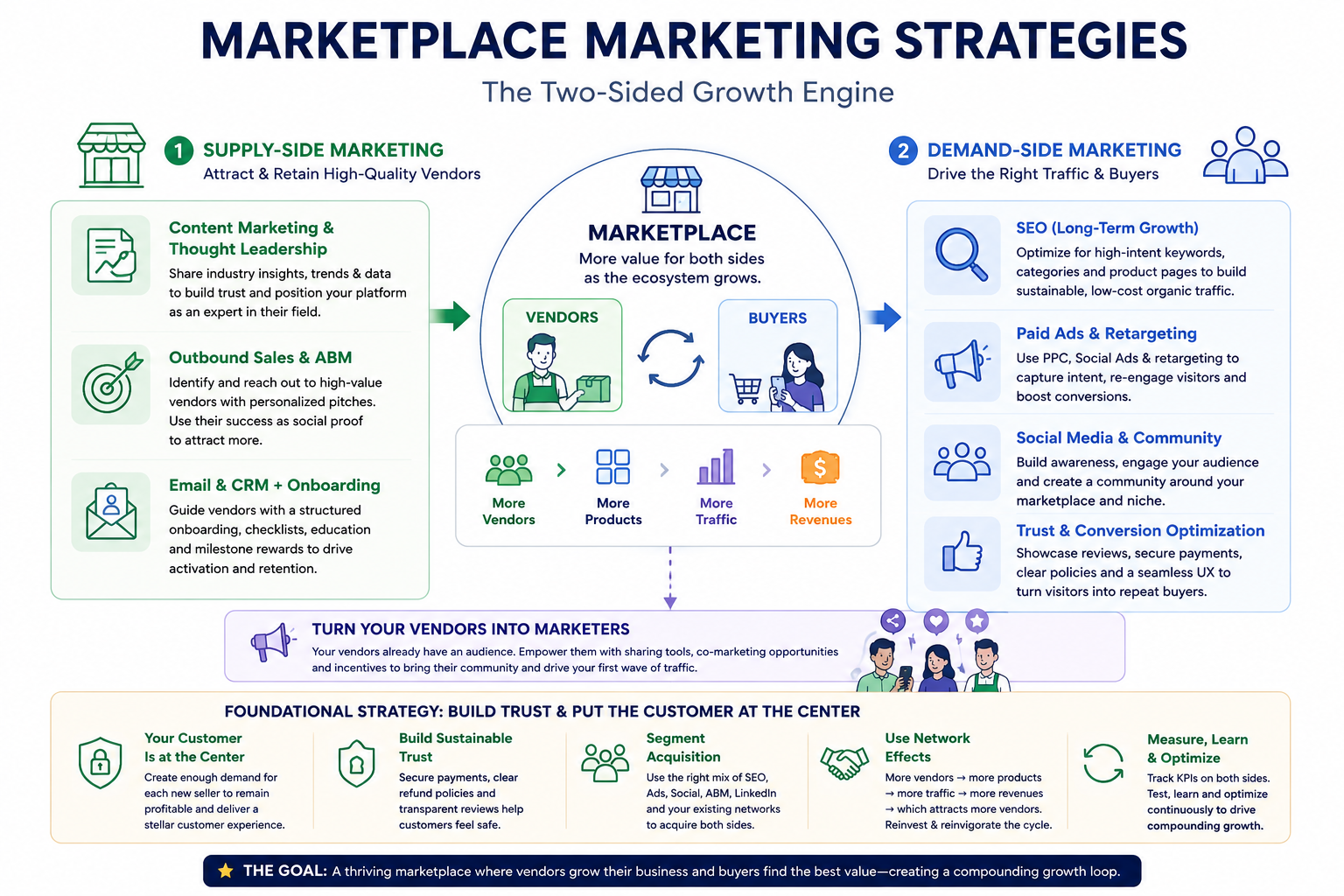

Marketing Strategies for B2C & B2B Marketplaces
Marketplace marketing is challenging because it requires managing a two-sided ecosystem. You need to attract vendors to bring in buyers and maintain enough buyers to keep vendors engaged. But how can you get enough buyers for your sellers, and enough sellers for your buyers? It's a modern paradox, and we provide some elements of answers in this article.
Top Insights
Your customer is at the center. Create enough demand for each new seller to remain profitable, and make sure you offer a stellar customer experience.
Build sustainable trust. The essential assets for your marketplace must include secure payments, clear refund policies, and transparent reviews, because customers want to feel safe before buying any of your products.
Segment acquisition. For B2C, create demand through the right SEO and social media strategies. For B2B, target supply and high-value buyers with ABM and LinkedIn. And use the networks you already have to get a head start.
Turn sellers into your first marketers. Your vendors already have an audience. Treat them as partners and tap into their networks to drive your first wave of traffic.
Foundational Strategy: Defining Your Ideal Profiles (ICP & Persona)
Before running any campaign, you need a precise picture of who sits on each side of your marketplace. "SMBs in the EU" or "procurement managers" are not ICPs, they're starting points. The goal is a profile specific enough to know exactly where to find these people and what to say to them.
For vendors, define:
Size: Are you targeting solo makers, SMBs with 5–50 employees, or established brands with existing distribution? Each has a different risk appetite for joining a new platform and a different capacity to manage a new sales channel.
Geography: Are they local (useful for logistics and trust), national, or already selling cross-border? A vendor already shipping internationally is far easier to onboard than one setting up their first export operation.
Current channels: Are they selling on Etsy, Amazon, or their own Shopify store? Understanding where they already sell tells you what they're used to, what fees they're paying, and what your platform needs to do better or differently.
Pain points: Common ones include high platform fees eating into margins, limited control over customer relationships, poor analytics, and slow payouts. The more specifically you can name the pain, the more credible your pitch.
For buyers, define:
In B2C: What's the average order value? Are they repeat buyers or one-time purchasers? What device do they buy on? A buyer spending €200 on a handmade item needs different reassurance than someone spending €20 on a consumable.
In B2B: What is the company size and industry? Who initiates the purchase (department head, procurement officer, end user)? What does their approval process look like: is there a vendor validation step, a budget cycle, a compliance requirement? What triggers a switch from their current supplier?
The sharper this picture, the less you waste on the wrong traffic, the wrong vendors, and the wrong message.
Supply-Side Marketing: Recruiting & Retaining High-Quality Vendors
Getting vendors onto a new marketplace should be a key focus at launch, requiring a significant outreach approach, but outbound progressively transfers to inbound as you scale and as your marketplace generates traffic. When you have a million monthly visitors, vendors come to you. Until then, you have to invest more time in convincing them.
Content Marketing & Thought Leadership
If you want to land top-tier sellers, you can't just be a platform. You have to be an expert in their field.
It's all about providing resources that help them grow their business. For example, if you are running a marketplace for organic skincare, publish data on ingredient trends or packaging sustainability. When you publish content in your sellers' vertical, it generates early organic traffic, and it signals that your platform understands your vendor's industry, therefore building trust.
Outbound Sales & Account-Based Marketing (ABM)
For B2B or high-end B2C marketplaces, waiting for vendors to find you isn't enough. You need a proactive outreach strategy. ABM is particularly effective here. Instead of a broad blast, identify the top 50 key vendors in your niche and create personalized pitches emphasizing their pain points or growth opportunities. Once onboarded, you can use their name to increase credibility.
Email and CRM
A well-tailored Email and CRM strategy helps you move sellers through the funnel. With a structured onboarding process, you can reduce friction and provide support to your new vendors at the right threshold points. Create checklists, tutorials, and milestone-based rewards. A seller who doesn't list a product within the first 48 hours is unlikely ever to become an active part of your community.
Demand-Side Marketplace Marketing Strategies: Driving the Right Traffic
Once you have a baseline of supply, the focus shifts to bringing in customers. Here are a few strategies you can develop straightaway.
Search Engine Optimization Tactics
If you are looking for a long-term strategy for your marketplace, SEO is the answer. It's the slow-and-steady work that builds a foundation for sustainable, low-cost traffic over time. Because marketplaces are naturally content-rich (thanks to thousands of product descriptions), you have a massive advantage.
Focus on long-tail keywords. Instead of trying to rank for "bicycles," target "second-hand carbon fiber road bikes in London." This captures high-intent users who are ready to make a decision. Ensure your platform uses a clean, crawlable architecture so search engines can easily index your growing catalog. Garnet's SEO-friendly structure on Shopify is designed with this in mind.
Paid Media in Your Marketplace Marketing Strategy
Paid advertising is the spark that launches your marketplace. They give you the initial thrust needed to get off the ground and prove your concept quickly. For B2C, Facebook and Instagram Dynamic Product Ads (DPAs) are great for retargeting users who viewed a product but didn't buy. For B2B, LinkedIn Ads work best for targeting job titles.
A key metric to consider is the Customer Acquisition Cost (CAC) vs. Lifetime Value (LTV). The CAC refers to the cost of acquiring a new customer, while the LTV estimates the total revenue generated by a customer over the course of their relationship with your business.
Social Media & Influencer Marketing
Social media has profoundly changed the way we do marketing. It's not just about ads anymore; your entire brand personality lives there, between reels, TikToks, and carousels.
In the B2C space, influencers are your strongest allies. When an influencer sends their audience to your site, they are putting their own reputation on the line. You need a professional infrastructure that prioritizes transparency and data protection to ensure you deliver a flawless customer experience while safeguarding both the influencer's brand and yours.
Referral & Word-of-Mouth
A happy customer will tell others about your product. Having a referral program that rewards both the referrer and the referee is key to scaling your business. This works particularly well when the incentive is immediate and the action is frictionless. In B2C, a discount code automatically issued after a completed purchase is simple and converts well. In B2B, it can be a formal partner program, where consultants earn commission for bringing clients onto the procurement platform.
Retention & Lifecycle Marketing: Getting the Flywheel Moving
Acquiring new customers is expensive. The real money is in keeping the ones you already have, and that means giving them reasons to come back again and again.
Email Marketing & Automation
Focus on abandonment and post-purchase flows, and set up automated recommendations for related products from the same vendor or similar sellers. Tools like Klaviyo or Brevo, which integrate with Garnet, make it easier to segment your audience based on their past purchases.
Push Notifications Strategy
If your marketplace uses a mobile app, push notifications are a great way to reach your audience. The key is relevance: a generic notification is spam, but a notification about a 24-hour sale on a brand the user follows is a service. Your notifications should be based on user behavior, preferences, and demographics, and use personalized messages to improve engagement and conversions.
Operational Marketing: Trust as a Competitive Advantage
In a marketplace, your brand is the sum of your sellers' behaviors. If one vendor fails to ship a product, the customer blames you, the platform. Operational marketing — the way you handle the "boring" stuff — is actually a powerful growth tool.
Reviews & Social Proof
Recent studies report that 95% of buyers read reviews before making a purchase. High-quality reviews from real customers provide the social proof needed to convert a skeptic into a customer. Showing that a seller has a 99% on-time shipping rate is more valuable for building trust than a 5-star rating on a generic product.
Customer reviews are essential, and on a new marketplace you won't have them by default. Here's how to build them systematically:
Trigger the ask at the right moment: send an automated review request 5–7 days after confirmed delivery, early enough that the experience is fresh, late enough that the buyer has actually used the product.
Reduce friction to one step: link directly to the review form. Every additional click drops completion rate significantly.
Incentivize without distorting: a small discount on the next purchase in exchange for a review increases volume without biasing the rating, as long as it's offered regardless of what the buyer writes.
Import existing vendor reviews: if your vendors are already selling on other platforms, ask them to share review data you can display.
You can also highlight vendor operational KPIs such as on-time shipping rate, average response time, or return rate.
Customer Support & Dispute Resolution
If your customer has a bad experience on your platform, you are wasting your marketing money. A transparent, fair refund and return policy acts as a high-conversion marketing feature. When a buyer knows they are protected if a transaction goes wrong, their potential risk drops to zero.
In the early stages of your marketplace, handle every dispute personally. This is not scalable long-term, but it is essential at launch. A single unresolved dispute — a late shipment, a product that doesn't match the description, a refund that takes three weeks — can generate public reviews, social posts, or chargebacks that damage your entire platform's reputation, not just one vendor's.
Orchestrating the Full Funnel
To sustain your growth, you need a technical partner who understands that marketing efficiency starts with the product itself.
Garnet Marketplace was built by people who have been in your shoes and understand your struggles.
We didn't just build another app; we built a technical partnership to support you every step of the way. With over 200 marketplaces supported worldwide and an average 4.9-star rating, Garnet provides the infrastructure — from 6-minute vendor onboarding to automated multi-vendor payouts — that lets you focus on growth rather than fixing bugs.
It doesn't matter if you're building a small B2C community or a massive B2B procurement engine. Your technology should be your best marketing tool, not the thing that holds you back.
FAQ
How do you start marketing a marketplace with zero users?
Start by hand-picking a small group of great vendors. Then use targeted ads or direct outreach to bring in just enough buyers to create your first, small, working ecosystem. Test it and repeat before scaling. Our guide to starting a marketplace on Shopify walks through this process step by step.
Is SEO or paid media better for marketplace growth?
Both are essential. Paid ads are the spark: they get you immediate results and prove your concept. SEO is the slow burn that delivers sustainable, low-cost traffic for years to come. A healthy strategy uses paid to fund early growth while SEO compounds in the background.
What is the most effective B2B marketplace marketing channel?
LinkedIn and Account-Based Marketing (ABM) are typically the most effective. They allow you to target specific professional roles and industries, reaching the exact procurement officers or department heads who have the authority to make high-value purchasing decisions.
How do I protect customer data while sharing order information with vendors?
As a marketplace operator, you are a data controller and legally responsible for all customer data processed on your platform, regardless of which vendor fulfilled the order. Garnet is built to handle this correctly: customer and order data stays in Shopify, while Garnet stores only the vendor data strictly needed to operate the marketplace. Vendors never have direct access to raw customer data. Read our full guide on data protection for marketplaces for a detailed breakdown of your obligations under GDPR, CCPA, and PDPA.
How should I handle refunds and returns without damaging my brand?
The key is to own the process centrally rather than leaving it to vendors. Set up a single intake channel for complaints, publish a clear return policy that assigns responsibility (buyer fault, seller fault, or bad luck), and have vendors sign off on it at onboarding. When issues arise, communicate decisions to both buyer and seller promptly. Garnet's built-in messaging system and order management tools centralize these workflows. Read our full refunds & returns guide for a step-by-step process.
How can I leverage my vendors' existing audiences to drive traffic?
Provide vendors with ready-to-use co-marketing kits: customized graphics, product descriptions optimized for their social channels, and unique referral links that track traffic back to your marketplace. This turns every vendor into a low-cost acquisition channel. It works best when vendors don't already have their own e-commerce store, since your marketplace represents their primary sales channel and they are naturally more motivated to promote it.
How do I build trust on a new marketplace that has no reviews yet?
Start by importing existing reviews from vendors who are already selling on other platforms and ask them to share that data with you. In parallel, trigger automated review requests 5–7 days after delivery and reduce friction by linking directly to the review form. You can also display vendor operational KPIs early on — on-time shipping rate, average response time — to signal reliability even before reviews accumulate. For data protection compliance and clear refund policies, make these highly visible to build buyer confidence from day one.
At what point should I shift budget from vendor acquisition to buyer acquisition?
A useful rule of thumb: once you have enough supply in your niche that a buyer landing on your marketplace finds at least 3–5 relevant products per search query, you have enough supply to justify investing in demand. Before that threshold, buyer acquisition spend is largely wasted because visitors leave without finding what they need. Use Garnet's analytics to monitor catalog depth by category and make this shift data-driven rather than arbitrary.