
Appearance

B2B & B2C Marketplace Growth Strategies
What's the most complex challenge you faced with your marketplace?
Recruiting vendors? Increasing website traffic? Managing your technology stack? All relevant topics, and not always obvious in which order to cover them.
As a former CTO of a $500M-valued marketplace, I have been in your shoes and have built a methodology first for myself, then for the 200+ marketplaces supported by Garnet over the past 5 years.
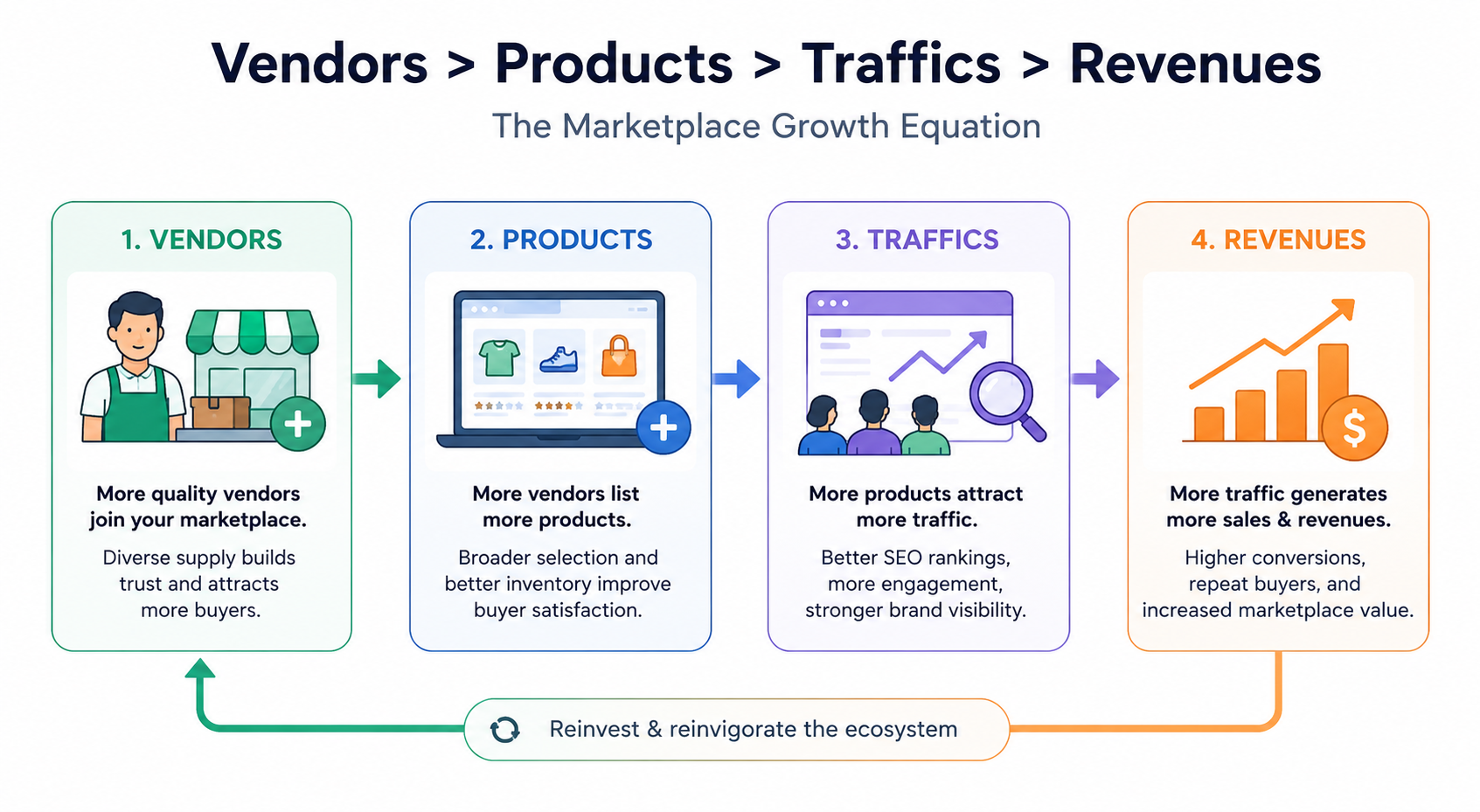
Here is our equation: Vendors > Products > Traffic > Revenues.
Therefore, as a marketplace owner, you need to do the following, in this specific order:
- Set up a professional and reliable multi-vendor solution
- Recruit & retain vendors
- Acquire customers
In this guide, we'll break down this model.
Key Takeaways
Platform choice is foundational. Your marketplace software needs to handle vendor onboarding smoothly, reliably automate operations, and scale with you, so it never becomes the limiting growth factor.
Vendor Experience drives Growth. The easier you make it for sellers to join, list products, and get paid, the faster your supply-side will grow. A frictionless and risk-free vendor experience is a powerful competitive advantage.
Build a Diversified Demand Engine. Sustainable customer acquisition relies on more than just paid ads. A healthy marketing strategy needs a combination of SEO, strategic performance marketing, and community-led growth for sustainable, long-term success.
Set Up a Professional and Reliable Multi-Vendor Solution
When vendor onboarding is painful, when syncing is broken, when daily activity is unclear — i.e., when your platform works against your vendors — vendors reach out to your team, take your time, drain your energy, and eventually churn.
Which means no products, no traffic, no revenues. And you spend all your time maintaining vendors, instead of investing in them. Meaning no scaling opportunity. That is why choosing the right platform comes first.
In the short term, you need a solution that makes vendor onboarding simple, delivers a smooth user experience for both admins and sellers, and provides the reliability required to run day-to-day marketplace operations efficiently. Long-term, manual processes stop scaling. You need a platform that automates operational work, adapts to your workflows, and remains flexible enough to support future customization and growth.
That's exactly what Garnet delivers, not just marketplace software, but a long-term partner helping you scale through a professional platform and hands-on support.
Supply-Side Growth: Attracting and Retaining Quality Vendors
Your vendors are not just users; they are your partners. When your sellers are happy, they list more products, offer better prices, and promote your marketplace to their networks. That is why the vendor experience is the most important and most overlooked lever for marketplace growth.
Some platforms have a difficult setup for sellers. The friction they create kills momentum and devalues the overall vendor experience. The key to attracting and retaining vendors lies in simplicity and efficiency. Your strategy should be to eliminate every possible point of friction for your sellers, from application to their first sale. It includes seamless onboarding, intuitive product management, and transparent communication. Here's a step-by-step guide to elevating your vendor experience.
Optimizing the Seller Onboarding Funnel
Scaling your supply side from 10 vendors to 1,000 requires going beyond manual processes. As your marketplace grows, you need technical systems that make it effortless for sellers to join and manage their inventory.
The key is to look for a platform with these capabilities:
Automated store sync: the gold standard — it allows vendors to sync their existing e-commerce store (such as Shopify or WooCommerce) with your marketplace. It automatically imports their products and, crucially, maintains real-time stock-level synchronization. For vendors, it's as easy to sell on your marketplace as on their own store.
Bulk product uploads: vendors with large catalogs need to upload all their products at once using a simple CSV file.
Intuitive vendor dashboard: provide sellers with a platform experience similar to Shopify, where they can easily review, edit, and manage products without technical complexity.
Clear documentation & FAQ: give vendors immediate access to answers for common onboarding, product, fulfillment, and operational questions, reducing support requests and improving autonomy. Garnet's full documentation is available to all vendors and operators.
These features remove the single biggest point of friction for sellers: manual data entry. For our client MadeIt, Australia's leading handmade marketplace, switching to Garnet's streamlined systems improved their team's operational efficiency by 40%. That's the time they reinvested in marketing and community building.
Define an Attractive Offer for Vendors
To successfully grow your marketplace, you need an offer that not only captures vendors' attention but feels too valuable to ignore. The right positioning will depend on your business model, target sellers, and marketplace category, but the key is to remove friction, reduce risk, and clearly communicate value.
Here are a few examples of offers for vendors:
- "Unlock a premium sales channel in just 2 clicks. We handle the setup, drive traffic to your products, and you only pay a commission when you sell."
- "Join the largest [industry] community, benefit from shared visibility and marketplace traffic, and only pay once you reach €1,000 in cumulative sales."
- "Join 100s of sellers already selling on the platform. Free to join. No monthly fees. Live in 15 minutes. Connect your Shopify or WooCommerce store and only pay when you sell."
In the early stages of a marketplace, when your brand is still unknown, vendors need more support — onboarding, setup, and active guidance — which become part of your value proposition. As your marketplace grows and gains visibility, the focus naturally shifts from operational support to pure exposure and traffic generation, making the platform easier to scale with less hands-on effort per vendor.
With Garnet, you can build flexible vendor models to attract high-quality sellers and create a scalable, profitable marketplace ecosystem.
Set Up a Vendor Outreach Plan
Once your onboarding funnel is ready and your vendor offer is attractive, recruiting sellers becomes a matter of process and consistency.
A strong vendor acquisition strategy typically includes identifying the main communication channels used by your target vendors, preparing a multi-channel outreach sequence with 5 touchpoints, setting up a CRM or tracking spreadsheet to monitor vendor status and follow-ups, building qualified lists of potential vendors, and following up consistently until you receive a response.
When responses are negative, use the feedback to understand objections and refine your positioning or offer. When responses are positive, schedule a 30-minute onboarding call to complete the setup together and ensure a smooth start.
Once your acquisition process is fully operational, marketplaces can onboard up to 20+ vendors per week. From there, the focus can gradually shift toward increasing marketplace traffic.
Demand-Side Growth Strategies: Driving Sustainable Traffic
Once your vendor product catalog is ready, your next step is to get a constant stream of buyers exactly where you need them: in your marketplace. A common mistake is relying solely on paid advertising, which is expensive and unsustainable. A better, more sustainable marketplace growth strategy uses a balanced mix of channels to drive customer acquisition.
Improved UX
Ensure you have invested enough time in the website user experience. A slow interface will bleed customers left and right, no matter how much you spend on ads. As you scale, it's important to invest in a clean customer journey, powerful search and filtering, clear communication channels between buyers and sellers, and a checkout process that inspires trust.
Organic Traffic
Search Engine Optimization (SEO) is a well-known and effective strategy to start with, as it focuses on capturing organic demand. This is something that can already be improved directly within Garnet.
Writing blog articles and posting them on Shopify is another great way to generate traffic and impressions. For example, The Vocal Market published 35 articles over 5 weeks, resulting in a 4x increase in impressions and a 2x increase in clicks.
Being present on social media (e.g., LinkedIn, Instagram) is also a great way to create a customer base. For instance, Vegan America created a ~300K community on Instagram over the past 3 years.
Paid Traffic
Paid advertising can also be a highly effective lever for marketplaces, especially for accelerating growth in the early stages or supporting specific campaigns. Unlike SEO, which compounds over time, paid traffic allows marketplaces to generate visibility and visits immediately.
Identify your ICP, start with a low budget, check the conversion rate, and progressively increase.
Vendor-Led Growth
Sometimes you can also leverage your vendor base by providing them with easy-to-use co-marketing kits, customized graphics, or unique referral links. This strategy creates powerful, low-cost growth as your vendors drive highly motivated buyers directly into your marketplace. This model works particularly well when your vendors don't have their own e-commerce store.
Explore our deep-dive article on marketing strategies for marketplaces.
Choosing the Right Foundation for Scale
Scaling a marketplace can be a daunting journey, since many platforms work well for 10 vendors but crumble under the operational load of thousands of vendors. And the technology you choose at the beginning can either make or break that journey.
We built Garnet to solve the real-world challenges of scale. We have supported 200+ marketplaces, which gives us insights into both the technical requirements and the business realities of building, launching, and scaling multi-vendor marketplaces.
With automated vendor payouts, easy store sync, and a suite of tools designed for the best vendor experience, Garnet provides the technical foundation you need to build a strong business. You don't know how to code? We do. We are your technical partners, ready to help you navigate every stage of your marketplace growth.
Are you ready to build your marketplace with a platform designed for scale?Book a demo with our team and see how Garnet can power your growth.
FAQ
Should I focus on supply or demand growth first?
The right order is: platform first, then supply, then demand. Before recruiting vendors or running ads, your technical foundation needs to be solid — a broken onboarding or unreliable sync will waste every vendor relationship you build. Once the platform is ready, focus on recruiting a concentrated, high-quality supply within a specific niche. Only then does investing in demand make sense, since you now have the products to convert visitors into buyers. Read our complete guide to starting a marketplace on Shopify for a step-by-step breakdown.
What commission rate should I charge my vendors?
A good starting point is 20%. At Garnet, we generally advise against commissions below 10% as it leaves little margin to run the business. Marketplaces selling digital products can charge 50% or more, since there are no shipping or inventory costs involved. The right rate depends on your niche, the value you bring to vendors, and the competitive landscape. Contact us and we can advise based on your specific industry.
How do I avoid the cold-start problem on a new marketplace?
The cold-start problem — having no vendors because there are no buyers, and no buyers because there are no vendors — is best solved by niching down aggressively at launch. Recruit a small cohort of high-quality vendors in a tight category first, use direct outreach rather than waiting for inbound, and make your first sales offline if needed. A focused supply of 10 excellent vendors is far more powerful than 100 mediocre ones when building initial buyer trust.
How long does it typically take to onboard a vendor with Garnet?
A guided onboarding call typically takes 15 to 20 minutes. Those with existing Shopify or WooCommerce stores can sync their full catalog automatically. Vendors with large catalogs can also use CSV bulk upload to import hundreds of SKUs in a single operation.
What is the best channel to acquire my first vendors?
Direct outreach remains the most effective channel for early vendor acquisition. Identify where your target sellers spend time (industry forums, LinkedIn groups, trade events) and build a 5-touchpoint outreach sequence. Use a simple CRM or spreadsheet to track status. Once you have a repeatable process, marketplaces typically onboard 20+ vendors per week.
Can I charge vendors a monthly subscription in addition to commissions?
Yes. Garnet supports flexible membership plans allowing you to combine a subscription fee with a commission model. This is useful for creating tiered vendor tiers — for example, a free plan with a higher commission rate, and a paid plan with a lower commission rate — which incentivizes committed vendors to invest in your platform.
How do I handle vendor payouts at scale?
Garnet supports fully automated vendor payouts via Stripe Connect. You configure a payout schedule (periodic or relative to fulfillment date), and Garnet handles the reconciliation and distribution automatically. This removes a major operational bottleneck as your vendor count grows, and ensures every seller is paid on time without manual intervention.
What does a good vendor offer look like at the early stage vs. at scale?
At the early stage, when your brand has limited traffic, your offer must lean heavily on reducing risk and providing hands-on support: free onboarding, setup help, and active guidance. As your platform grows and generates consistent traffic, the offer shifts naturally toward exposure and revenue potential — the platform sells itself. Garnet helps you operationalize both stages through its vendor application system, onboarding tools, and analytics dashboard.