
Mercado Libre
The "Amazon of Latin America" — a marketplace fused with the Mercado Pago fintech and Mercado Envíos logistics network into one dominant regional ecosystem
Visit Mercado Libre
- Status
- Active
- Country
- AR
- Region
- Argentina, Brazil, Mexico, Chile, Colombia, Latin America (18 countries)
- Category
- horizontal-b2c
- Model
- B2C / C2C / B2B
- Founded
- 1999
- Website
- mercadolibre.com
- Headquarters
- Montevideo, Uruguay
- Parent
- —
- GMV (USD/yr)
- $65B/yr
Screenshots
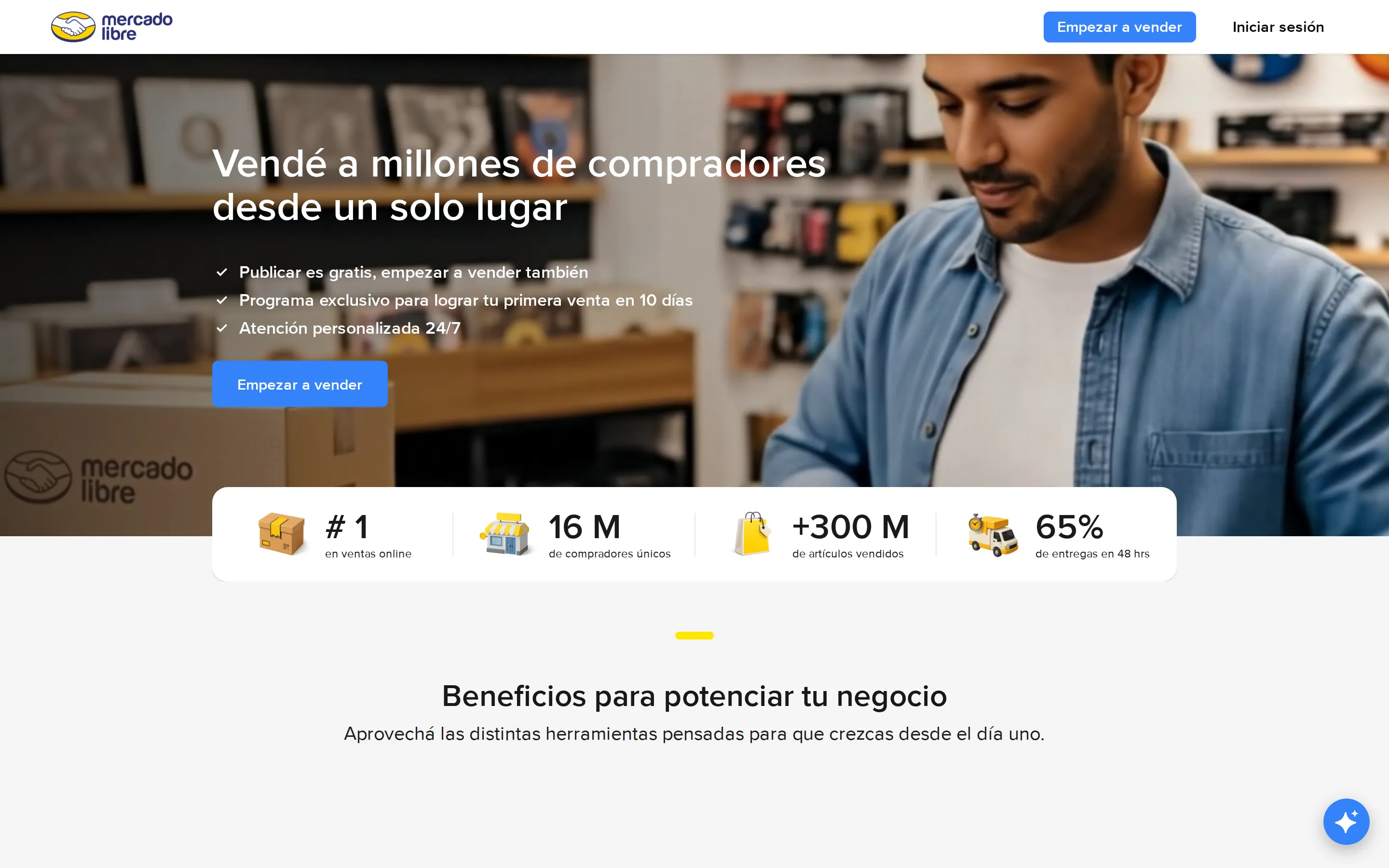
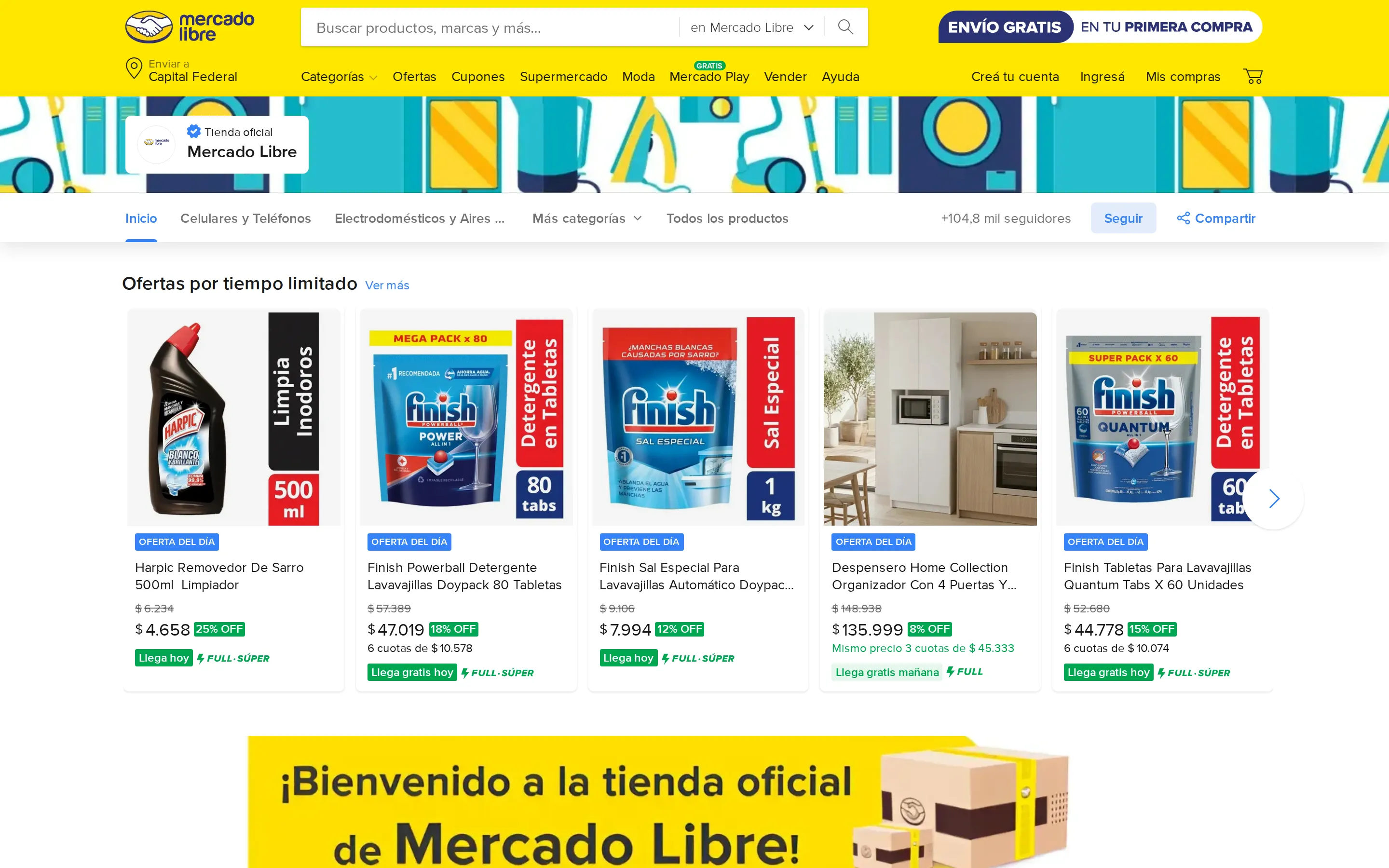
Overview
Mercado Libre (MercadoLibre, Inc.; “Mercado Livre” in Brazil) is the largest e-commerce and fintech ecosystem in Latin America, operating an online marketplace across 18 countries. Founded in Buenos Aires, Argentina in 1999 by Marcos Galperin, it is headquartered in Montevideo, Uruguay and incorporated in Delaware, USA. It has traded on the NASDAQ under the ticker MELI since 2007, when it became the first Latin American technology company to IPO there. Beyond the marketplace, the company runs Mercado Pago (payments and credit), Mercado Envíos (logistics/fulfillment), and Mercado Ads (retail media), together forming an integrated commerce-and-fintech flywheel that has made it Latin America’s largest company by market capitalization.
What they’re known for
Mercado Libre is famous not just for being “the Amazon of Latin America,” but for building the entire infrastructure of digital commerce in the region itself. In markets where trust, payments, and delivery were broken or non-existent, it created its own solutions: Mercado Pago solved the trust problem with escrow and digital wallets in a largely cash, low-credit-card region, and Mercado Envíos built a logistics and fulfillment network that now delivers over 75% of shipments within 48 hours. That vertically integrated ecosystem — marketplace + payments + logistics + credit + advertising — is its signature, creating a moat competitors have struggled to replicate. It is also renowned as the survivor that outlasted 80+ competitors after the dot-com bust.
History
- 1999 — Founded on August 2 in Buenos Aires by Stanford MBA Marcos Galperin, inspired by eBay.
- 2000–2001 — Survives the dot-com bust through radical cost-cutting (halved workforce, cut marketing ~90%) while rivals collapsed; ends 2001 with ~US$21.3M GMV.
- 2001 — eBay buys a 19.5% stake and agrees not to compete in the region for five years.
- 2003 — Launches Mercado Pago, its payments arm.
- 2007 — IPOs on NASDAQ (ticker MELI), the first Latin American tech company to do so; Galperin was 28.
- 2013 — Launches Mercado Envíos logistics service.
- 2016 — Opens “Melicidade,” a 17,000 m² tech HQ in São Paulo, Brazil.
- 2017 — Joins the NASDAQ-100 index.
- 2023 — Named to TIME’s list of the 100 most influential companies.
- 2025 — Surpasses 80 million quarterly marketplace buyers and ~78 million Mercado Pago monthly active users; reaches ~US$65B annual GMV and US$28.9B revenue.
Business model
Mercado Libre earns money across several intertwined segments. The core marketplace is predominantly third-party (3P): merchants, small businesses, and individuals list goods and Mercado Libre takes a commission plus listing/advertising fees, with some first-party (1P) direct sales layered on top. Its commerce take-rate reached roughly 25% of GMV by Q4 2025 (including shipping, ads, and fees). The fintech arm, Mercado Pago, monetizes payment processing, digital wallets, and a fast-growing credit book (~US$12.5B portfolio in 2025) at a fintech take-rate around 4.5%. Mercado Envíos monetizes fulfillment and shipping, while Mercado Ads (retail media) is a high-margin growth engine. The strategy is closer to Alibaba/eBay (connecting buyers and sellers) than pure first-party retail, but with Amazon-style logistics and fintech built in-house.
Why it succeeded
Multiple analyses point to a combination of discipline and vertical integration. As detailed in the Steady Compounding and Stanford GSB pieces, the company survived the dot-com crash by conserving cash — Galperin recalled having “$40 million in the bank” when competitors ran dry — which instilled a durable culture of capital discipline. The eBay partnership provided a playbook and five years of protection from a major rival. Crucially, it did not wait for the region’s infrastructure to mature: it built Mercado Pago to overcome low card penetration and trust barriers, and Mercado Envíos to fix delivery, turning the region’s biggest obstacles into competitive moats (per Quartr and GabGrowth). The resulting ecosystem creates high switching costs and network effects. With Latin American e-commerce still under-penetrated (the company holds only ~5% of total retail, per Motley Fool), it has combined a long runway with cash-flow positivity every year since 2007.
Notable facts
- ~US$65B GMV and US$28.9B revenue in 2025; US$1.99B net income (FY2025).
- Q4 2025 revenue up 45% YoY to ~US$8.8B; GMV US$19.9B (+37%); 752M units sold (+43%).
- Commerce take-rate ~25.0%; fintech take-rate ~4.5% (Q4 2025).
- ~78M Mercado Pago monthly active users (+27% YoY) and 80M+ quarterly marketplace buyers in 2025.
- Credit portfolio nearly doubled to ~US$12.5B in 2025, with NPLs (15–90 day) around 4.4%.
- Over 75% of shipments delivered within 48 hours; 16 new fulfillment centers opened in 2025.
- Latin America’s largest company by market cap (roughly US$100B+ range).
- First Latin American tech company to list on NASDAQ (2007); joined NASDAQ-100 in 2017.
Links
| Title | URL | Type | Note |
|---|---|---|---|
| Mercado Libre — Investor Relations | https://investor.mercadolibre.com/ | official-site | Official IR site; homepage www.mercadolibre.com bot-blocks automated fetches (403) |
| MercadoLibre — Wikipedia | https://en.wikipedia.org/wiki/Mercado_Libre | article | Company overview, history, FY2025 revenue/net income |
| Mercado Libre: The Digital Backbone of Latin America (Quartr) | https://quartr.com/insights/edge/mercado-libre-the-digital-backbone-of-latin-america | article | Ecosystem analysis across marketplace, fintech, logistics |
| MercadoLibre and Marcos Galperin: From Inception to Triumph (Quartr) | https://quartr.com/insights/business-philosophy/mercadolibre-and-marcos-galperin-from-inception-to-triumph | article | Founder story and key milestones |
| MercadoLibre Part 1: How They Survived When 80+ Competitors Failed | https://steadycompounding.com/investing/mercadolibre-part-1-survival/ | article | Post-dot-com survival and culture of capital discipline |
| Marcos Galperin: Growing Latin America’s Online Marketplace (Stanford GSB) | https://www.gsb.stanford.edu/insights/marcos-galperin-growing-latin-americas-online-marketplace | article | Founder interview on early strategy and cash discipline |
| Latin America’s Biggest E-Commerce Platform Is Growing Fast (Motley Fool) | https://www.fool.com/investing/2025/05/14/latin-americas-biggest-e-commerce-platform-is-grow/ | article | Growth, ~5% retail share, dual-engine business |
| Mercado Libre (Deep Dive) — GabGrowth | https://gabgrowth.com/p/mercado-libre-deep-dive | article | 14-section deep dive on moat and business model |
| Mercado Libre Dominance Deepens: Q4 Revenue Surges 45% | https://www.financialcontent.com/article/marketminute-2026-2-26-mercado-libre-dominance-deepens-q4-revenue-surges-45-as-logistics-and-fintech-synergy-redefines-latin-american-commerce | news | Q4 2025 results: revenue, GMV, take-rates, credit portfolio |
Build the next Mercado Libre
Mercado Libre started as one idea. Turn your Shopify store into a multi-vendor marketplace and let many sellers list, sell, and ship — you take a commission on every order. Book a call and we'll walk you through it.
Book a meetingBook a meeting with us
Schedule a free consultation to discuss your marketplace project and see how Garnet can help you launch and scale.
Our calls are available in English and French.
Or write us an email directly at contact@nospam.garnetmarketplace.com.invalid
