
StockX
The "stock market of things" bid-ask marketplace with mandatory physical authentication of every item before it ships to the buyer.
Visit StockX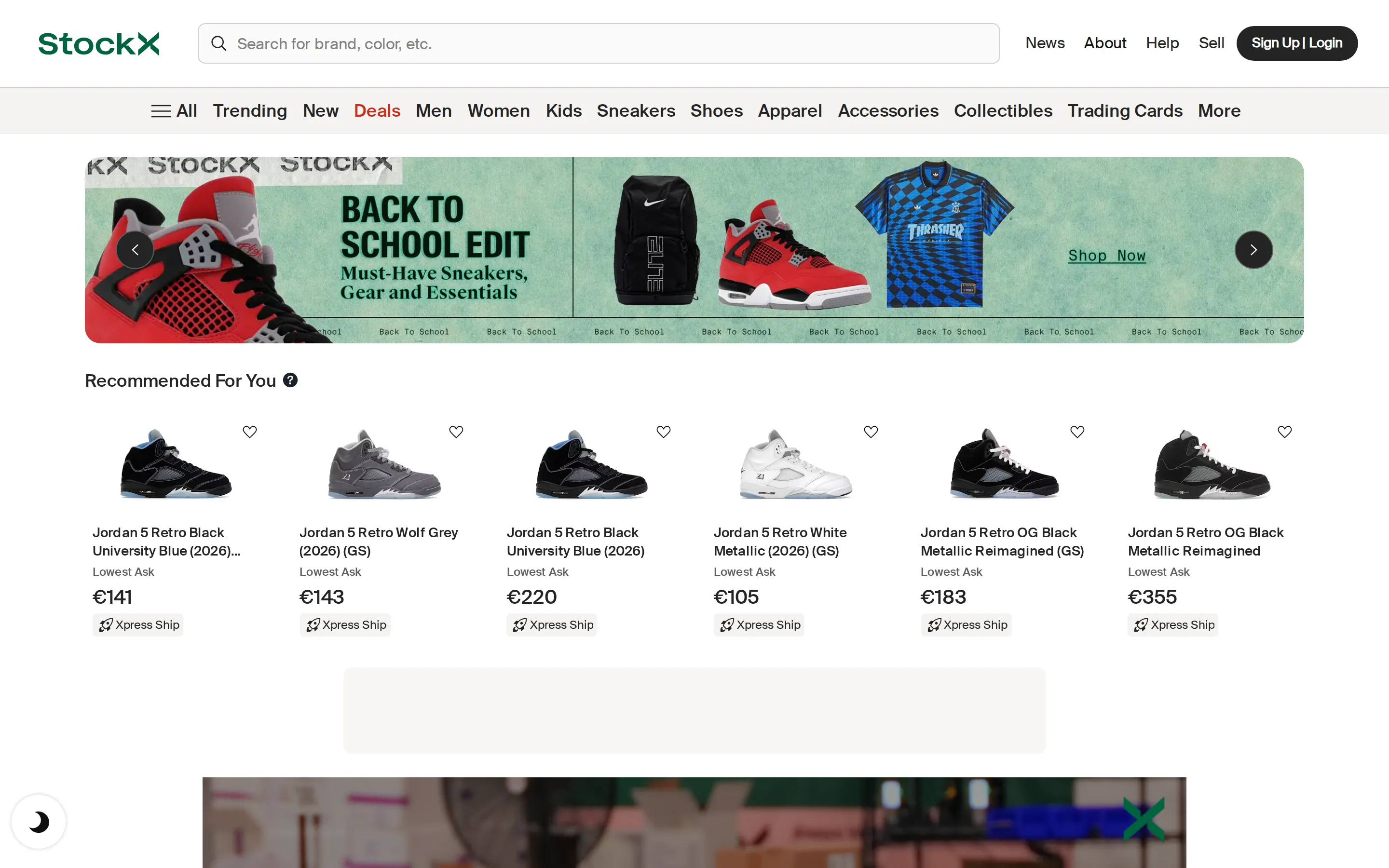
- Status
- Active
- Country
- US
- Region
- North America, Europe, Asia-Pacific, Global
- Category
- resale-recommerce
- Model
- C2C / B2C
- Founded
- 2015
- Website
- stockx.com
- Headquarters
- Detroit, USA
- Parent
- —
- GMV (USD/yr)
- $2.1B/yr est
Screenshots
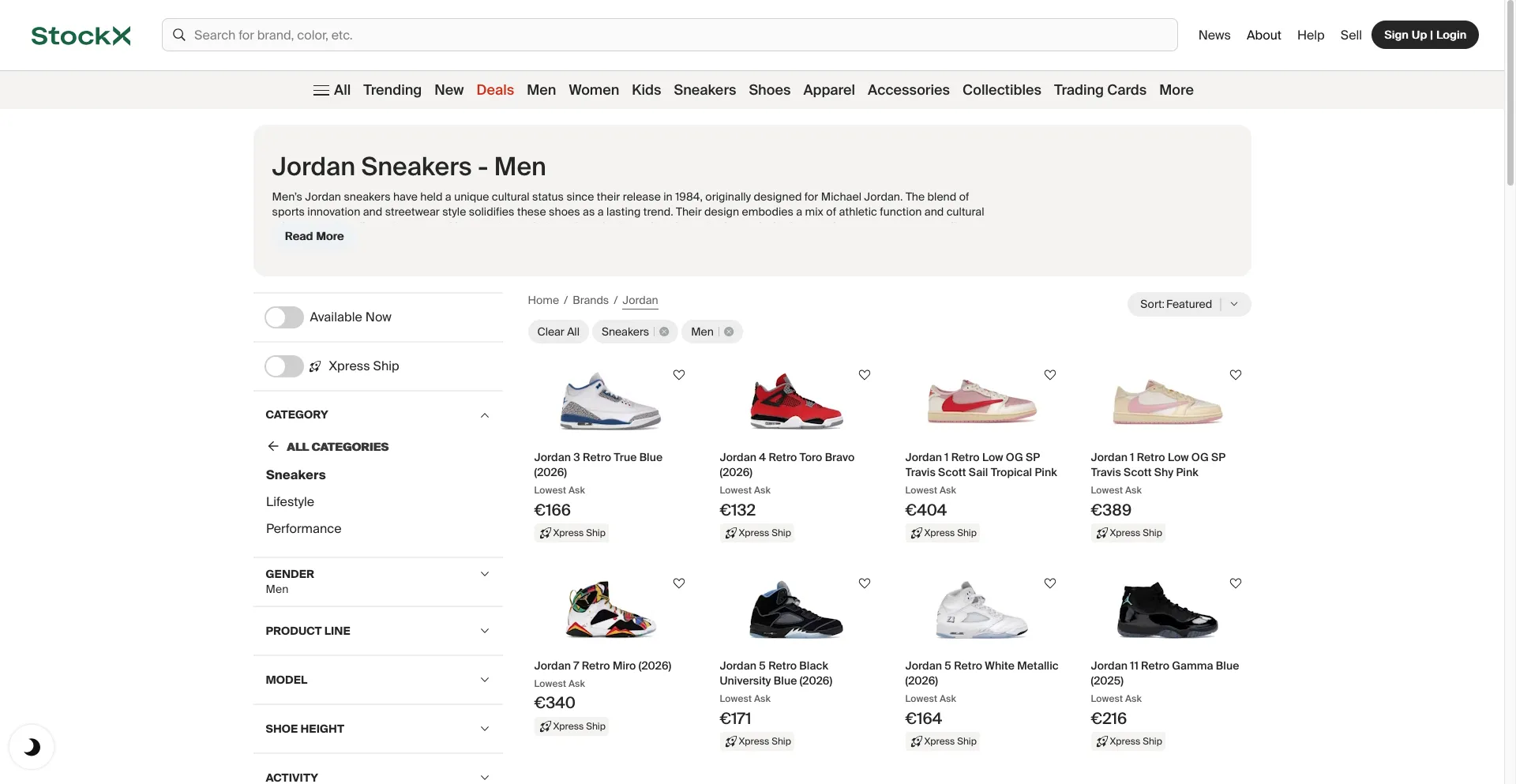
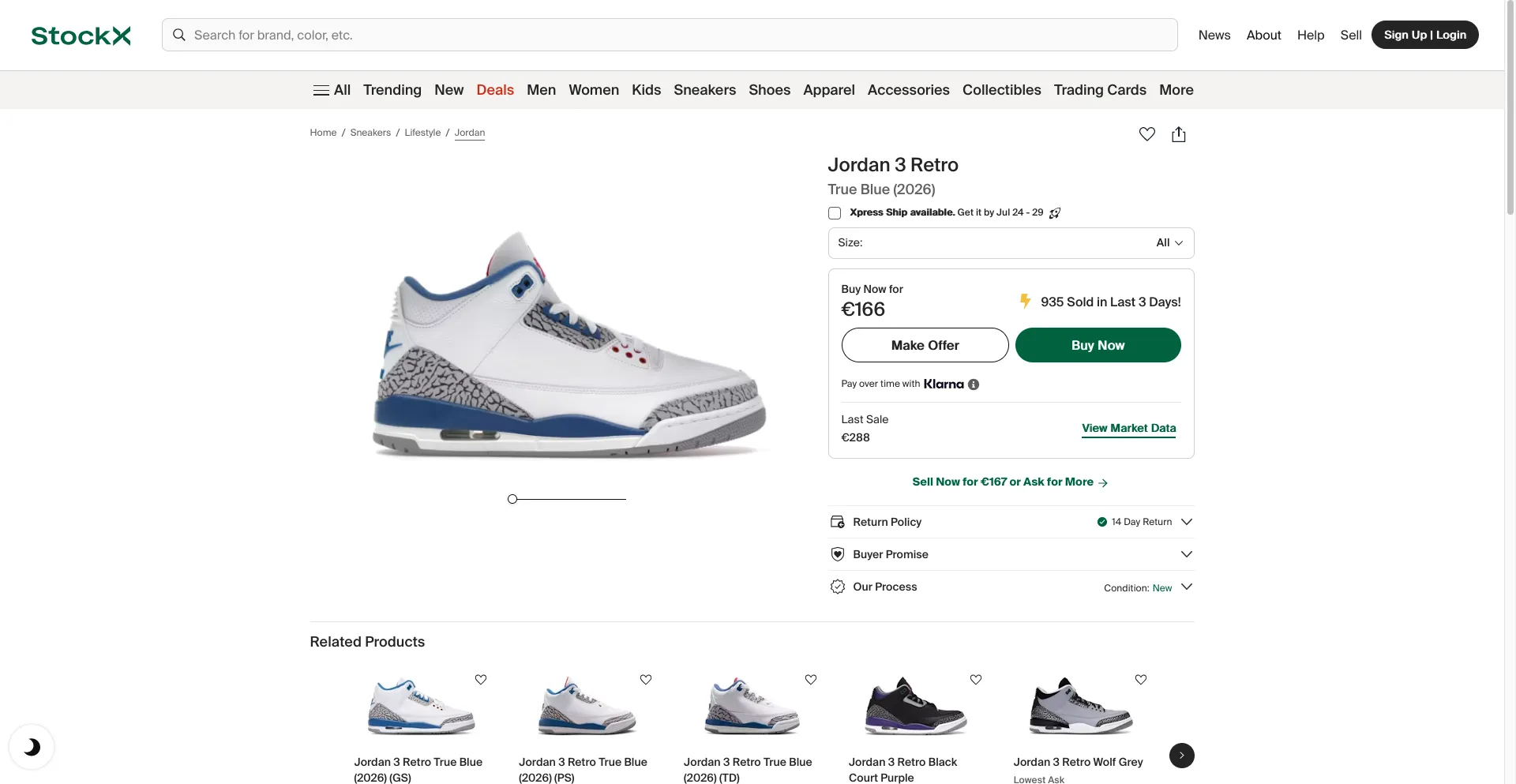
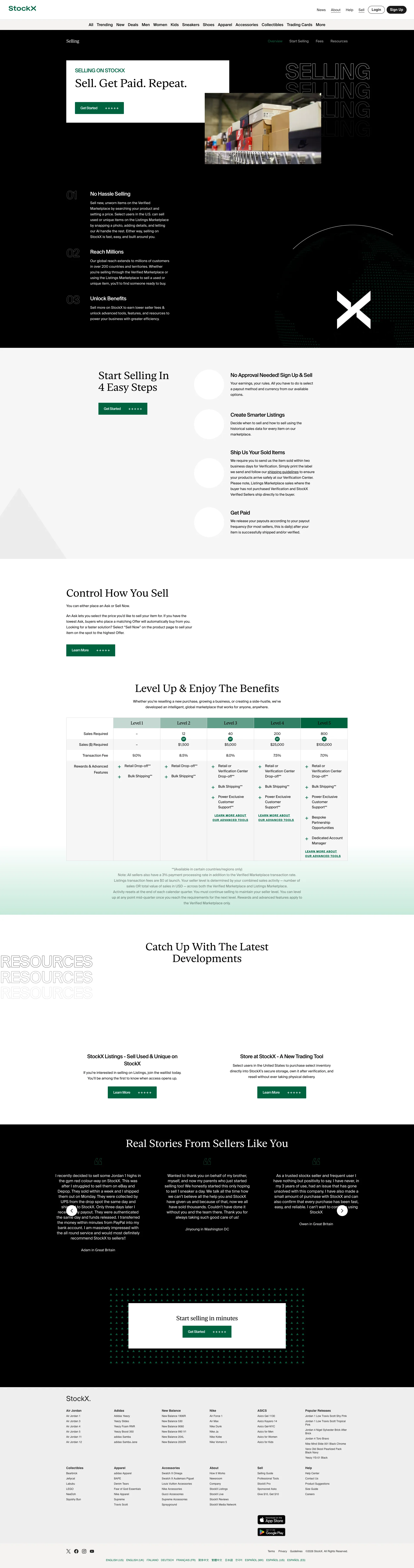
Overview
StockX is a Detroit-founded online resale marketplace best known for sneakers and streetwear, though it also trades handbags, apparel, watches, collectibles and (briefly) electronics. It applies stock-market mechanics to physical goods: buyers place “bids”, sellers set “asks”, and a trade executes when the two meet, giving every product a transparent, real-time market price. Founded in 2015 and launched in February 2016 by Dan Gilbert (Quicken Loans / Rocket founder), Josh Luber, Greg Schwartz and Chris Kaufman, it grew into one of the largest sneaker resale platforms in the world, reaching a $3.8 billion valuation in 2021. It remains a privately held company headquartered in Detroit, Michigan, with authentication centers in the US and Europe.
What they’re known for
StockX’s signature is the fusion of two ideas that no prior resale site combined at scale:
- The bid-ask “stock market of things” model. Instead of fixed listings and haggling, buyers and sellers are anonymous and prices are set by live supply and demand, complete with price history charts, 52-week highs/lows and last-sale data that look like a trading terminal. This grew out of co-founder Josh Luber’s earlier sneaker-pricing data project, Campless.
- Mandatory physical authentication. Every item is shipped first to a StockX verification center, inspected by human experts, and only then forwarded to the buyer. Sellers never ship directly to buyers. This “authenticate-before-ship” step is what StockX marketed as its trust guarantee (“100% Authentic”) and is the reason its take rate bundles a verification service into the platform fee.
History
- 2015 — Founded in Detroit by Dan Gilbert, Josh Luber, Greg Schwartz and Chris Kaufman, building on Luber’s Campless sneaker-data project.
- Feb 2016 — Platform publicly launches with the bid-ask marketplace and authentication model.
- 2019 — Reaches $1 billion valuation (“unicorn”) in June; suffers a data breach affecting millions of customer records mid-year.
- Nov 2020 — Expands beyond sneakers/apparel into electronics such as game consoles and smartphones; co-founder Josh Luber departs (Sept 2020).
- Apr 2021 — Raises capital at a $3.8 billion valuation; reports ~$3.8B GMV.
- Jan 2022 — Launches “Vault” NFTs tied to physical products.
- Feb 2022 — Nike sues StockX over the NFTs, later adding counterfeiting and false-advertising claims.
- 2022–2024 — Multiple rounds of layoffs (8% in June 2022, ~80 staff in Nov 2022, ~40 including the CMO in Jan 2024) amid a cooling resale market.
- Mar 2025 — Judge grants Nike partial summary judgment, finding StockX had sold counterfeit Nike sneakers.
- Aug 2025 — Nike and StockX reach a confidential settlement, dismissing the 3.5-year lawsuit with prejudice days before trial.
Business model
StockX is a pure third-party (3P / C2C-and-B2C) marketplace — it holds no inventory of its own and takes ~100% of GMV through third-party sellers. It makes money on a per-transaction take rate charged to sellers:
- Transaction (seller) fee: tiered by seller level, from ~9% at Level 1 down to ~7% (with performance bonuses reaching as low as 5%) for the highest-volume sellers.
- Payment processing fee: a flat 3% on every Verified Marketplace sale.
- All-in take rate: roughly 10–12.5% of sale price, with the cost of authentication bundled into the platform fee rather than billed separately.
- Sellers also pay inbound shipping to the authentication center (~$13–$16 prepaid label). A minimum seller fee (e.g. $5 in the US) applies to low-value items.
A separate “Listings Marketplace” model lets sellers keep the full sale price while buyers cover processing and shipping. The buyer-side experience is anonymous and price-driven, which is central to the platform’s liquidity.
Why it succeeded
StockX succeeded by solving the two biggest problems in peer-to-peer resale of hyped goods — price opacity and counterfeit risk — at the same time. The bid-ask engine gave a chaotic secondary sneaker market a single transparent clearing price, turning shoes into a quasi-tradable asset class and attracting both collectors and flippers (see the Contrary Research breakdown). Mandatory authentication addressed the fear that kept mainstream buyers out of resale, and StockX leaned on “100% Authentic” messaging as a core differentiator. Backed by Dan Gilbert’s Detroit capital and network, it scaled to tens of millions of trades and a $3.8B valuation.
That said, the model has real stress points. The Nike v. StockX litigation exposed that even a rigorous authentication pipeline let counterfeits through — a court found StockX liable for selling fakes (Fashion Dive) — which strikes at the platform’s central trust promise. A cooling post-pandemic resale market also forced repeated layoffs (Modern Retail). StockX remains active and the market leader in sneaker resale, but its growth has flattened from its 2021 peak.
Notable facts
- Reached a $3.8 billion valuation in 2021 (up from $1B in 2019).
- Roughly $3.8B GMV in 2021; ECDB estimates about $2.1B GMV in 2025, indicating flat-to-declining volume from the peak.
- Cumulatively facilitated on the order of 25 million+ trades and grew to ~20 million lifetime users by 2023.
- Take rate runs about 10–12.5% all-in (tiered transaction fee + flat 3% processing fee), with authentication bundled in.
- In the Nike case, StockX argued the disputed counterfeits were “0.0004% of the 17.8 million Nike sneakers” it reviewed during litigation, and claimed to have blocked $80M+ in suspected counterfeit sales.
- User base skews young: roughly 70% under age 35.
Links
| Title | URL | Type | Note |
|---|---|---|---|
| What are StockX’s fees for Sellers? | https://stockx.com/help/articles/what-are-stockxs-fees-for-sellers | official-site | Official fee schedule; seller-level transaction fees + 3% processing fee (homepage stockx.com bot-blocks WebFetch). |
| Lower Base Fees for All Sellers — StockX Seller Program | https://stockx.com/news/stockx-seller-program/ | official-site | Official StockX post detailing the tiered seller fee structure and bonuses. |
| StockX — Wikipedia | https://en.wikipedia.org/wiki/StockX | report | Overview of founding, founders, valuation history and business model. |
| Report: StockX’s Business Breakdown & Founding Story | https://research.contrary.com/company/stockx | report | Deep business analysis of the bid-ask model, GMV and take rate. |
| StockX Revenue and User Statistics (2024) | https://usesignhouse.com/blog/stockx-stats/ | report | Aggregated revenue, GMV, user and demographic statistics. |
| StockX Company & Revenue 2015-2027 | https://ecdb.com/resources/sample-data/retailer/stockx | report | GMV estimate (~$2.1B in 2025) and 100% third-party marketplace breakdown. |
| StockX confirms layoffs and CMO departure | https://www.modernretail.co/operations/stockx-confirms-layoffs-and-cmo-departure/ | news | Jan 2024 restructuring; history of layoff rounds since 2020. |
| Nike v. StockX: A Timeline Behind the Trademark Lawsuit | https://www.thefashionlaw.com/nike-v-stockx-a-timeline-behind-the-trademark-lawsuit/ | article | Full timeline of the NFT + counterfeiting lawsuit through settlement. |
| Nike, StockX counterfeit lawsuit will head to trial | https://www.fashiondive.com/news/nike-stockx-counterfeit-lawsuit-trial/742154/ | news | March 2025 ruling finding StockX liable for counterfeit sales. |
| Nike and StockX Settle Lawsuit After Three-Plus Years | https://www.soleretriever.com/news/articles/nike-stockx-settle-lawsuit-august-2025 | news | Aug 2025 confidential settlement; 38 of 60 inspected pairs found fake. |
Build the next StockX
StockX started as one idea. Turn your Shopify store into a multi-vendor marketplace and let many sellers list, sell, and ship — you take a commission on every order. Book a call and we'll walk you through it.
Book a meetingBook a meeting with us
Schedule a free consultation to discuss your marketplace project and see how Garnet can help you launch and scale.
Our calls are available in English and French.
Or write us an email directly at contact@nospam.garnetmarketplace.com.invalid
