
Rakuten
Japan's leading online marketplace fused with the Rakuten Points loyalty and financial-services ecosystem
Visit Rakuten
- Status
- Active
- Country
- JP
- Region
- Japan, United States, Europe, Asia (cross-border sellers from 10+ countries)
- Category
- horizontal-b2c
- Model
- B2C / B2B
- Founded
- 1997
- Website
- global.rakuten.com
- Headquarters
- Setagaya, Tokyo, Japan
- Parent
- Rakuten Group, Inc. (publicly listed, TSE 4755; founder-led)
- GMV (USD/yr)
- $40B/yr est
Screenshots
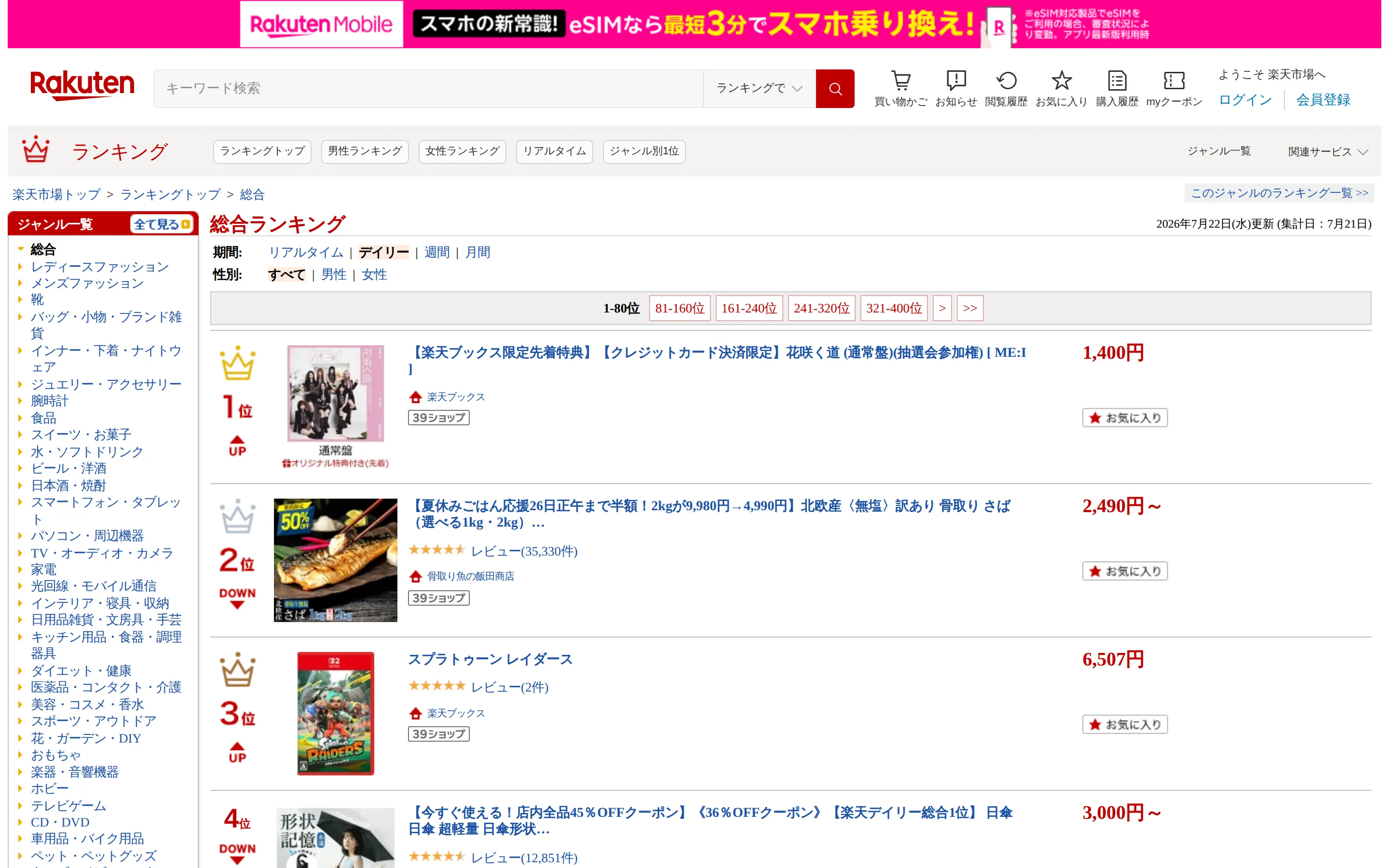
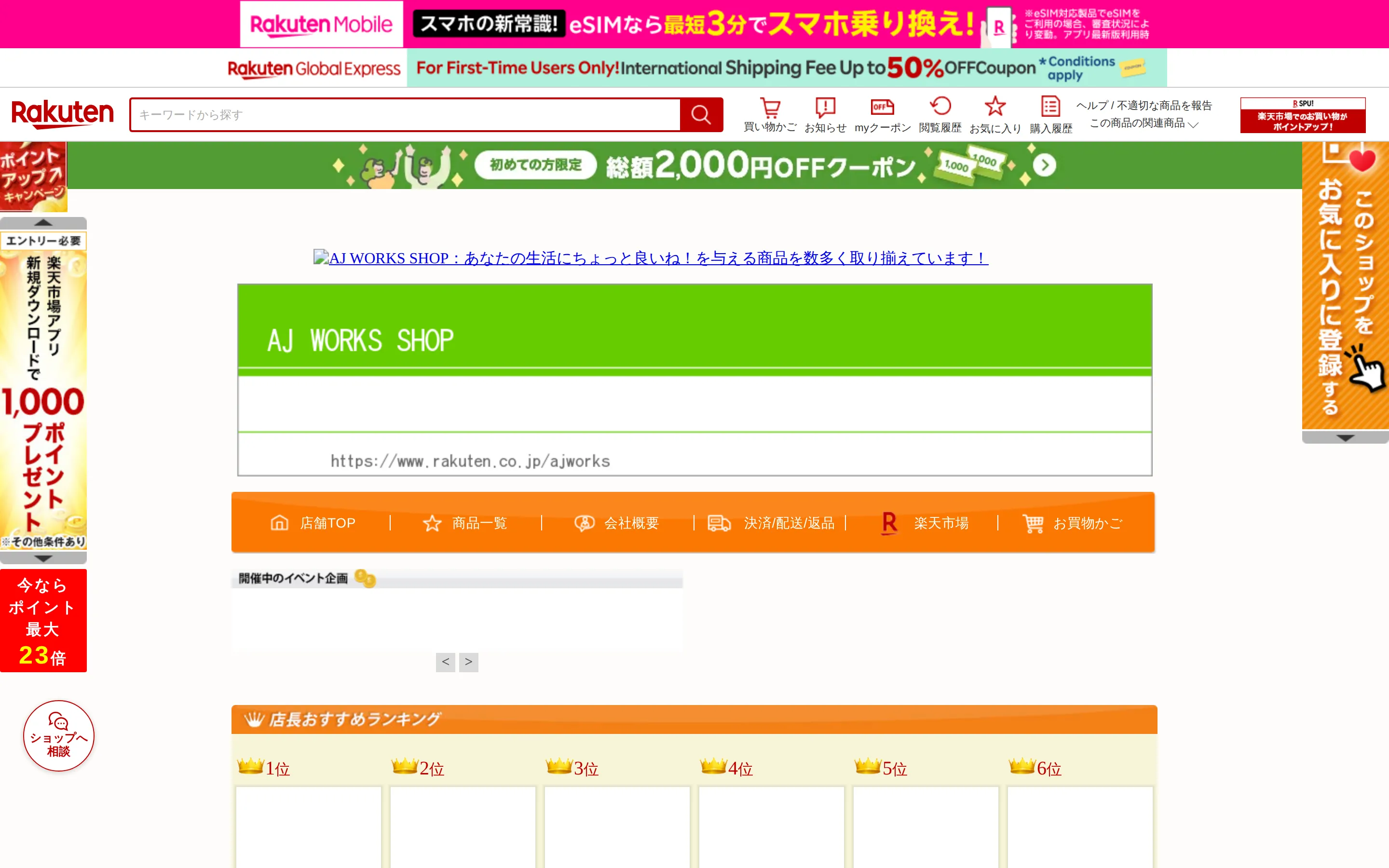
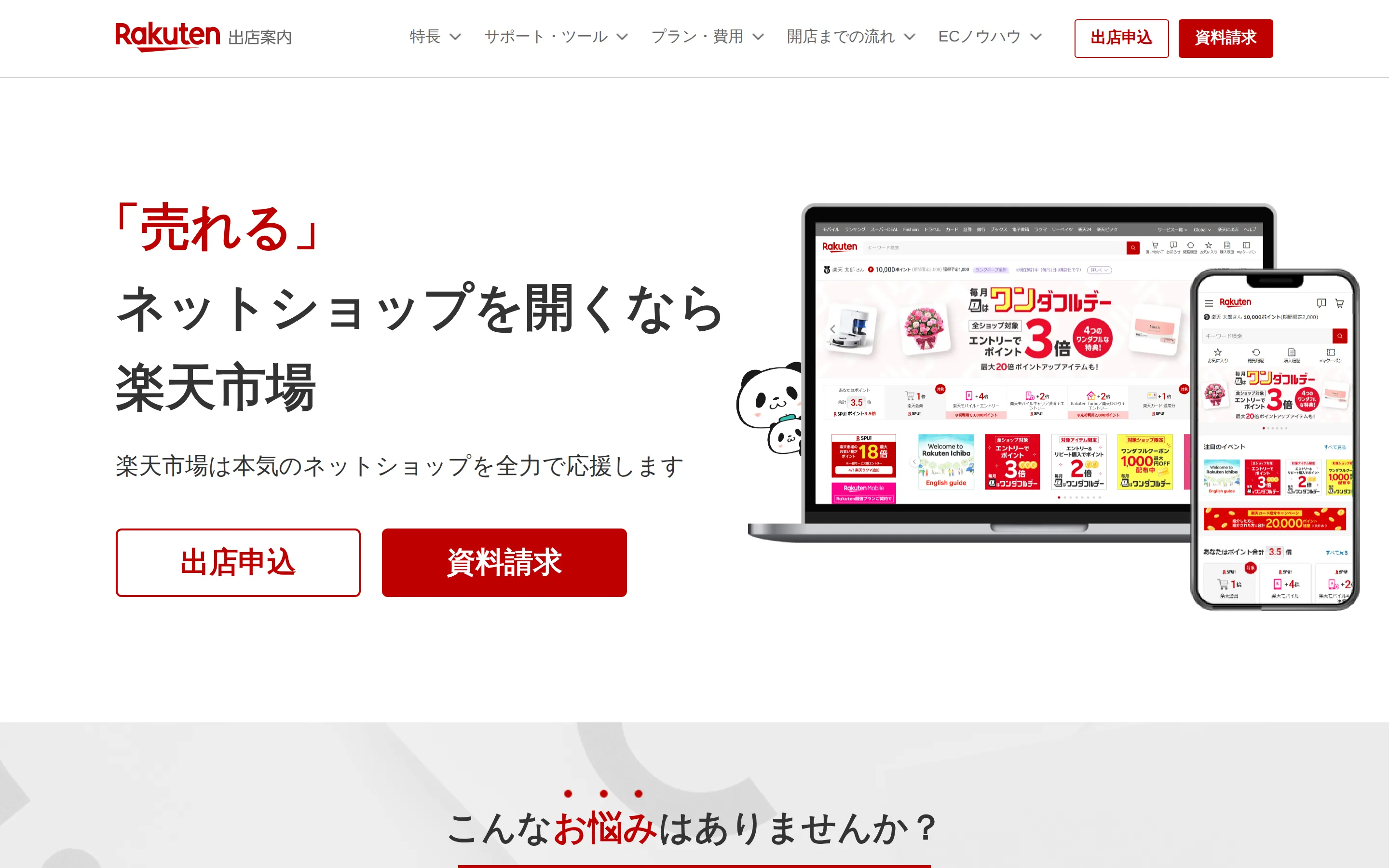
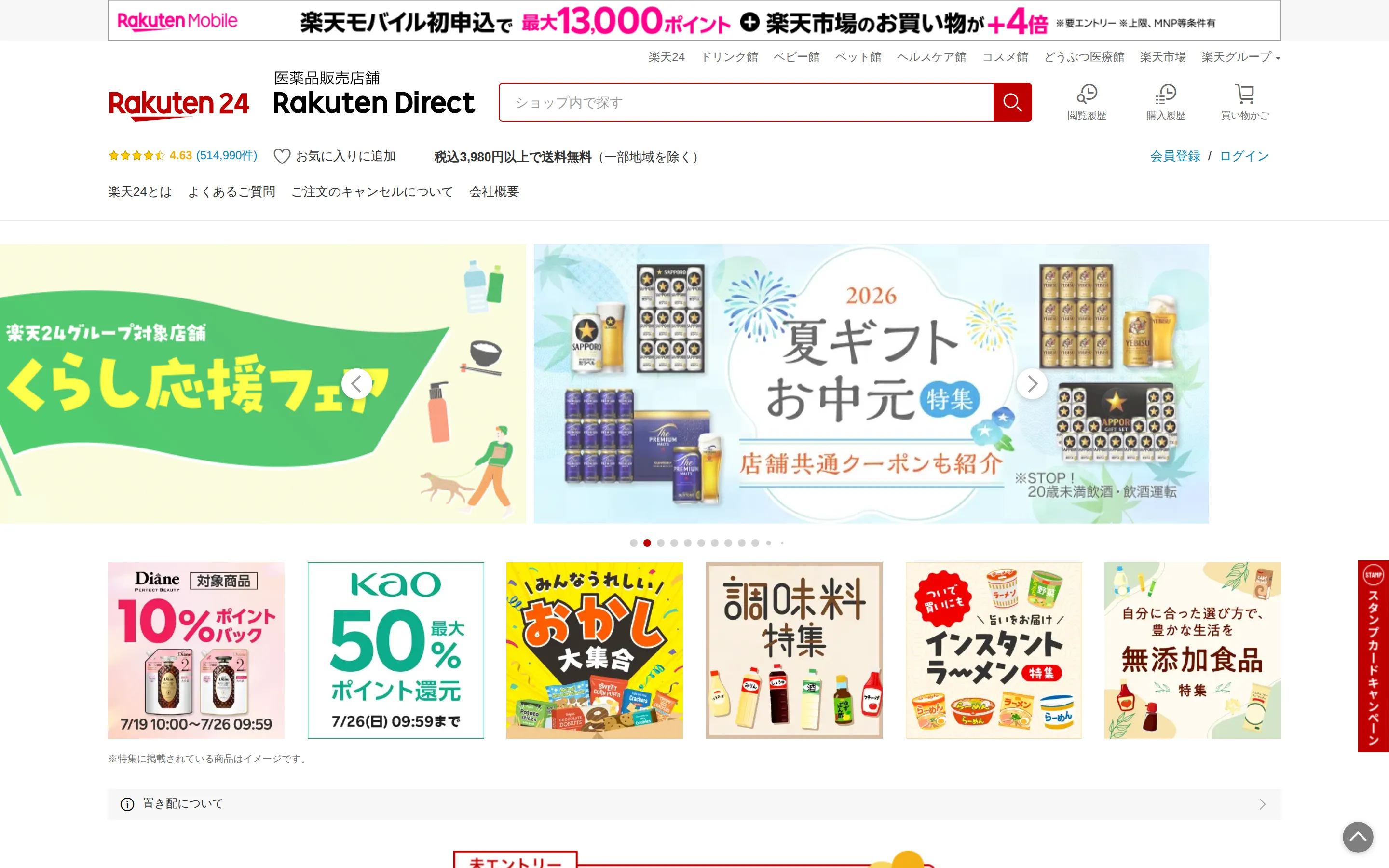
Overview
Rakuten (specifically its flagship marketplace, Rakuten Ichiba) is Japan’s largest home-grown online marketplace and the anchor of the wider Rakuten Group, a Tokyo-based conglomerate spanning e-commerce, fintech and mobile. Founded in 1997 by Hiroshi “Mickey” Mikitani, a former Industrial Bank of Japan banker with a Harvard MBA, it started as an internet shopping mall with six employees and 13 merchants and grew into a platform hosting more than 50,000 stores and over 100 million registered members. Today Rakuten Ichiba holds roughly a 27% share of Japanese e-commerce and sits inside an ecosystem that binds shopping, the Rakuten Card, Rakuten Bank, Rakuten Securities, Rakuten Travel and Rakuten Mobile together through a single loyalty-points currency.
What they’re known for
Rakuten’s signature is the “Rakuten Economic Zone” (Rakuten Ecosystem): a single membership and points program that follows the customer across dozens of services. Points earned shopping on Ichiba can be spent on mobile bills, travel, or investing, and mobile or card users get boosted point multipliers when they shop, which locks buyers into the ecosystem in a way a standalone store cannot. It is also known for being fiercely merchant-first: rather than a bare Amazon-style catalog, Ichiba gives each seller a richly customizable, branded storefront (built on Rakuten’s early Rakuten Merchant Server), so the platform reads more like a mall of independent shops than a single retailer. Culturally it is famous for Mikitani’s 2010 “Englishnization” mandate that made English the company’s internal working language.
History
- 1997 — Hiroshi Mikitani founds MDM, Inc. in Tokyo; launches Rakuten Ichiba on May 1 with 6 employees and 13 merchants.
- 1999 — Company renamed Rakuten; begins rapid expansion of its merchant base.
- 2000 — Rakuten lists on the JASDAQ market.
- 2000s — Diversifies into financial services (Rakuten Card, Rakuten Bank, Rakuten Securities) and travel, building the points-linked ecosystem.
- 2010 — Mikitani announces “Englishnization,” making English the company’s official business language.
- 2010s — Global M&A push: acquires Buy.com (US), PriceMinister (France), Kobo (e-books), Viber (messaging) and others; builds Rakuten as a global brand (including football/sports sponsorships).
- 2020 — Launches Rakuten Mobile as Japan’s fourth mobile carrier, built on a cloud-native network.
- 2024 — Domestic e-commerce GMS reaches ~5.96 trillion JPY; consolidated revenue hits a record ~2.3 trillion JPY, and the Group returns to full-year profitability for the first time in five years.
- 2025 — Expands Rakuten Ichiba’s international seller program to Singapore and six more countries (Belgium, Finland, New Zealand, Norway, Sweden, Switzerland); Rakuten Mobile surpasses 10 million subscribers on December 25.
Business model
Rakuten Ichiba is predominantly a third-party (3P) marketplace: it does not own most inventory but hosts independent merchants who run their own branded storefronts, and monetizes them through a mix of seller subscription/plan fees plus a variable sales commission (broadly in the low-to-mid single digits up to the mid-teens percent depending on category and plan), on top of optional advertising via Rakuten Ads. This “success-based” model aligns Rakuten’s revenue with merchant sales rather than charging heavy upfront fees. The far larger strategic engine, however, is the ecosystem: the Group also earns from Rakuten Card interchange, Rakuten Bank deposits, securities, insurance and Rakuten Mobile, and it uses generous points and first-party transaction data to cross-sell members between services. E-commerce functions partly as a customer-acquisition funnel for higher-margin fintech, so profitability is measured across the whole “Rakuten Economic Zone,” not the marketplace alone.
Why it succeeded
- Merchant-first storefronts. From day one Rakuten let non-technical shopkeepers build rich, customizable pages via the Rakuten Merchant Server, so sellers built real brands on the platform instead of being commoditized, a deliberate contrast to Amazon’s uniform listings (Rakuten founding story).
- The points-linked ecosystem. Binding shopping, cards, banking, travel and mobile under one membership and one points currency created powerful lock-in and cross-sell; ~20% of Ichiba shoppers are Rakuten Mobile users, and the “Rakuten Economic Zone” lets the Group weather external shocks (FY2024 results).
- Local dominance against Amazon. Rakuten built a ~27% share of Japanese e-commerce and reaches roughly 75-80% of Japanese consumers, standing as the local champion where many US platforms failed to dominate Japan (Japan marketplace comparison).
- Diversified, ecosystem-wide monetization. Because e-commerce feeds higher-margin fintech and mobile, the Group grew revenue for 28 consecutive years and returned to full-year profitability in FY2024 (FY2024 results).
- Founder vision and global ambition. Mikitani’s early bet on Japanese online shopping (when 94% of access was dial-up) and later moves like Englishnization and cross-border seller programs kept the company expanding (How does Rakuten make money).
Notable facts
- Grew from 6 employees and 13 merchants in 1997 to 50,000+ stores and 100M+ registered members.
5.96 trillion JPY ($37-40 billion) in domestic e-commerce GMS in 2024; ~27% share of Japanese e-commerce.- ~2.3 trillion JPY consolidated revenue in FY2024, up 10% YoY and a 28th consecutive year of growth.
- Rakuten Card quarterly shopping value reached ~6.7 trillion JPY (Q3 FY2025), up 11.7% YoY.
- Rakuten Bank held ~12.2 trillion JPY in deposits and 17.3M accounts by September 2025.
- Rakuten Mobile passed 10 million subscribers on December 25, 2025, ~5 years and 8 months after launch.
- Over 1,000 overseas-affiliated merchants now sell on Ichiba via its cross-border seller program.
Links
| Title | URL | Type | Note |
|---|---|---|---|
| Rakuten Group, Inc. (corporate site) | https://global.rakuten.com/corp/ | official-site | Official global corporate website |
| Rakuten - Wikipedia | https://en.wikipedia.org/wiki/Rakuten | article | Overview of founding, segments and history |
| Hiroshi Mikitani - Wikipedia | https://en.wikipedia.org/wiki/Hiroshi_Mikitani | article | Biography of the founder/CEO, incl. Englishnization |
| Rakuten’s 20th Anniversary: Our founding story | https://rakuten.today/blog/founding-story.html | article | Official first-person account of the 1997 founding |
| Rakuten Group FY2024 and Q4 FY2024 Financial Results Highlights | https://global.rakuten.com/corp/news/press/2025/0214_01.html | report | Official FY2024 revenue, GMS and profitability figures |
| Rakuten Group Q3 FY2025 Financial Results Highlights | https://global.rakuten.com/corp/news/press/2025/1113_01.html | report | Latest quarterly segment and fintech metrics |
| Rakuten Ichiba Opens Doors to Singapore-based Businesses | https://global.rakuten.com/corp/news/press/2025/0709_01.html | news | Cross-border seller expansion; cites 27% share and ~6T JPY GMS |
| Rakuten Ichiba Expands International Merchant Network to Six New Countries | https://global.rakuten.com/corp/news/press/2025/0930_03.html | news | 2025 international seller program growth |
| Rakuten Mobile Surpasses 10 Million Subscribers | https://global.rakuten.com/corp/news/press/2025/1225_01.html | news | Mobile milestone strengthening the ecosystem |
| How does Rakuten make money? | https://www.sharetribe.com/how-to-build/how-does-rakuten-make-money/ | article | Breakdown of marketplace fees, commission and revenue streams |
| Rakuten commissions: how Rakuten Marketplace fees and commissions work | https://www.heropay.eu/en/blog/rakuten-commission | article | Seller-side commission tiers and subscription plans |
| Comparison of Japan’s Top Three E-Commerce Marketplaces | https://nextlevel.global/blog/2025/10/22/japan-ecommerce-marketplace-comparison/ | article | Amazon vs Rakuten vs Yahoo Shopping GMV and share |
Build the next Rakuten
Rakuten started as one idea. Turn your Shopify store into a multi-vendor marketplace and let many sellers list, sell, and ship — you take a commission on every order. Book a call and we'll walk you through it.
Book a meetingBook a meeting with us
Schedule a free consultation to discuss your marketplace project and see how Garnet can help you launch and scale.
Our calls are available in English and French.
Or write us an email directly at contact@nospam.garnetmarketplace.com.invalid
