
Depop
Social, mobile-first Gen-Z fashion resale where secondhand shopping feels like scrolling a feed
Visit Depop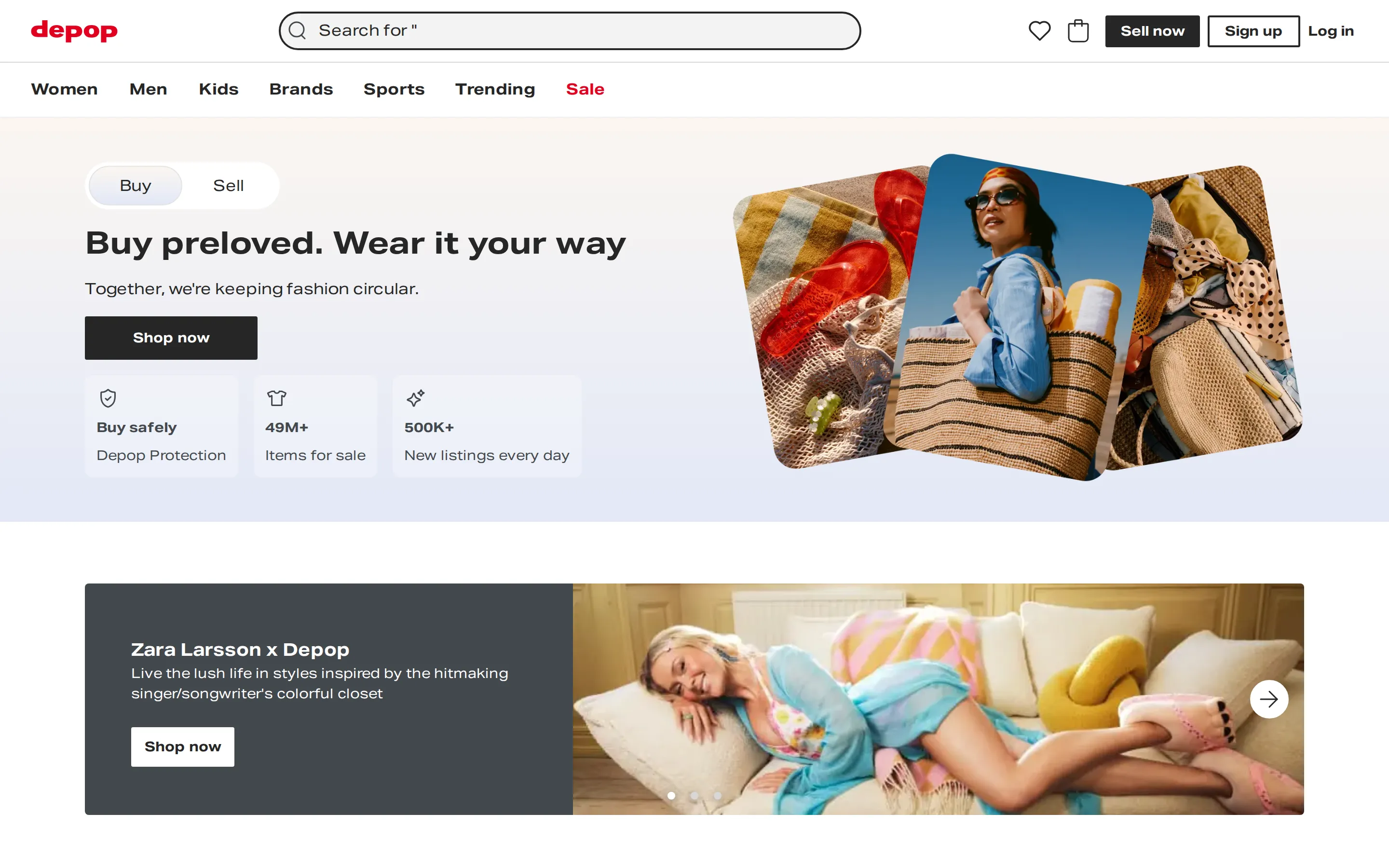
- Status
- Acquired
- Country
- UK
- Region
- United Kingdom, United States, Australia, Europe, 150+ countries
- Category
- resale-recommerce
- Model
- C2C / B2C
- Founded
- 2011
- Website
- depop.com
- Headquarters
- London, United Kingdom
- Parent
- Etsy, Inc.
- GMV (USD/yr)
- $620M/yr
Overview
Depop is a community-powered fashion resale marketplace where people buy and sell secondhand, vintage, and independent clothing. Founded in Italy in 2011 by Simon Beckerman and headquartered in London since 2012, it blends the mechanics of a social network — profiles, follows, likes, and a scrollable feed — with a peer-to-peer marketplace. It is best known as the go-to resale destination for Gen Z, with roughly 90% of its active users under the age of 26. Since July 2021 it has operated as a standalone brand inside Etsy’s “House of Brands,” alongside Reverb and Elo7, after Etsy acquired it for approximately $1.625 billion.
What they’re known for
Depop’s signature is turning secondhand shopping into a social, mobile-native experience. Rather than a utilitarian listings grid, the app looks and feels like Instagram: sellers curate aesthetic shopfronts, buyers follow accounts, and discovery happens by scrolling a feed and browsing style-driven trends (Y2K, vintage, streetwear). This made thrifting aspirational and creator-led, and it is the reason Depop became cultural shorthand for Gen-Z resale — “they come to Depop for the clothes, but stay for the culture.” Roughly 80% of users are Gen Z and about 85% of purchases happen through the app.
History
- 2011 — Founded by Simon Beckerman at the H-FARM incubator in Italy, initially tied to his creative magazine PIG as a way for readers to buy featured items.
- 2012 — Headquarters relocated from Italy to London.
- 2013–2015 — Early funding rounds (Red Circle Investments, Balderton Capital, Holtzbrinck Ventures); Runar Reistrup becomes CEO.
- 2018 — $20M Series B led by Octopus Ventures.
- 2019 — $62M Series C led by General Atlantic; Maria Raga leading as CEO.
- June 2, 2021 — Etsy announces agreement to acquire Depop for ~$1.625 billion, primarily cash.
- July 13, 2021 — Acquisition completes; Depop becomes a standalone Etsy brand. It had ~30M registered users across 150+ countries at the time.
- July 2024 — Depop removes seller fees in the US (following the UK) and shifts to a buyer-paid marketplace fee model.
- 2025–2026 — GMV grows ~18% year over year after the fee change; publishes annual Gen-Z trend reports (“The Edited Self,” 2026).
Business model
Depop is a predominantly third-party (C2C) marketplace: individuals and small independent sellers list their own inventory, and Depop takes a cut of the transaction flow rather than holding stock. Historically it charged sellers a 10% commission on each sale plus payment processing. In 2024 it overhauled this: it eliminated the 10% seller fee (UK first, then the US from July 2024) and introduced a buyer-side “marketplace fee” of up to ~5% of item price plus a fixed amount up to ~$1. Sellers now pay only payment processing (roughly 3.3% + $0.45 via Depop Payments), positioning Depop as one of the lowest-cost major resale platforms for sellers. Additional revenue comes from Boosted Listings (an advertising product charging ~8% of sale price for higher placement) and brand partnerships. The strategy: lower seller friction to grow supply/inventory, and shift monetization to buyers who receive purchase protection.
Why it succeeded
- Social-first product design. By making the app feel like a social feed rather than a classifieds board, Depop captured Gen-Z behavior that legacy resale (eBay) and utilitarian rivals missed — engagement and mobile usage are its standout metrics, per the Gitnux and business-model breakdowns.
- Right audience, right moment. It rode the convergence of Gen-Z’s sustainability values, thrift/vintage culture, and creator economics; ~90% of users are under 26 (per the Etsy acquisition release and Depop newsroom).
- Creator-led supply. Individual sellers building branded “shops” turned users into a self-reinforcing marketplace, giving distinctive inventory that mass retailers can’t replicate.
- Validated by a landmark exit. Etsy’s ~$1.625B all-cash purchase — its largest acquisition, and one of Europe’s notable tech exits — confirmed Depop had built durable value in the resale category.
- Aggressive fee reform. The 2024 zero-seller-fee move (which lifted GMV ~18%) contrasts sharply with rivals like Poshmark, which tried and quickly reversed a similar shift — evidence Depop executed the transition well.
Notable facts
- Acquired by Etsy for ~$1.625 billion in cash, completed July 13, 2021 — Etsy’s largest-ever acquisition.
- ~90% of active users are 26 or younger; ~80% are Gen Z.
- ~85% of purchases happen through the mobile app.
- GMV reached roughly $620M in 2025, up ~18% after the fee change; ~$788M gross merchandise sales in 2024.
- Had ~30M registered users across 150+ countries at acquisition; later reported 35M+ registered users.
- Raised roughly $105M in venture funding before the Etsy deal.
- For H-FARM, its early Italian backer, the exit produced a reported ~15.5x return on investment — the deal is cited as one of Italy’s notable startup unicorns.
Links
| Title | URL | Type | Note |
|---|---|---|---|
| Depop newsroom (official) | https://news.depop.com/ | official-site | Official company newsroom and press hub |
| Etsy completes acquisition of Depop | https://www.prnewswire.com/news-releases/etsy-completes-acquisition-of-depop-the-global-fashion-resale-marketplace-for-gen-z-301331913.html | news | Confirms ~$1.625B, July 13 2021 close |
| Depop removes selling fees in the US, evolves fee structure | https://news.depop.com/company-news/depop-removes-selling-fees-in-the-united-states-evolves-fee-structure/ | news | Primary source on the 2024 zero-seller-fee change |
| Depop unveils 2026 Fashion Trends Report: “The Edited Self” | https://news.depop.com/company-news/depop-unveils-2026-fashion-trends-report-the-edited-self/ | report | Example of Depop’s Gen-Z trend reporting |
| Depop valuation, funding & news (Sacra) | https://sacra.com/c/depop/ | report | Valuation (~$1.62B) and funding history |
| Depop becomes a “unicorn” (H-FARM) | https://www.h-farm.com/en/news/depop-app-fashion-secondhand-startup-unicorn-acquired-etsy-simon-beckerman-riccardo-donadon | article | Founding at H-FARM and exit multiple |
| Depop History and Ownership (2011-2024) | https://retailboss.co/depop-history-and-ownership/ | article | Milestone timeline and ownership |
| How Does Depop Work? (business model) | https://businessmodelcanvastemplate.com/blogs/how-it-works/depop-how-it-works | article | Revenue streams and fee mechanics |
| Depop Statistics: 2026 Verified Data & Trends (Gitnux) | https://gitnux.org/depop-statistics/ | report | User, engagement, and revenue statistics |
Build the next Depop
Depop started as one idea. Turn your Shopify store into a multi-vendor marketplace and let many sellers list, sell, and ship — you take a commission on every order. Book a call and we'll walk you through it.
Book a meetingBook a meeting with us
Schedule a free consultation to discuss your marketplace project and see how Garnet can help you launch and scale.
Our calls are available in English and French.
Or write us an email directly at contact@nospam.garnetmarketplace.com.invalid
