Compare Multi-Vendor Ecommerce Businesses
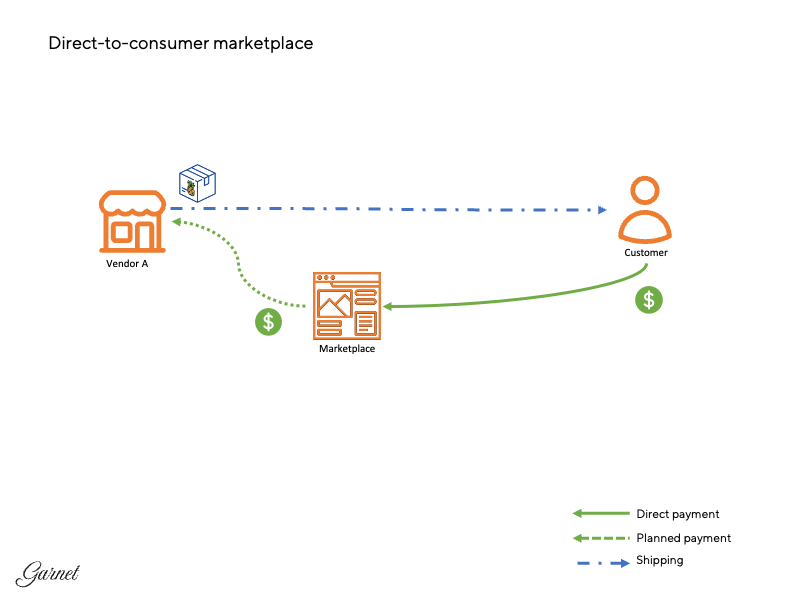
Are you looking to start an online business to sell products? Then you have several options to choose from! We’ll look at all different options you can do to sell vendor products online.
Marketplace vs traditional ecommerce
A traditional ecommerce (also called Direct shipping) sells their own products that are stored in their shop or warehouse. On top of managing their inventory, (possibly) product manufacturing, and logistics, they have to sell their products.
A marketplace (also called multi-vendor marketplace) is a business facilitator who relays sales orders to their vendor partners. A marketplace lists other vendors’ products. Based on the business model, the marketplace is more or less involved in the payment processing, shipping, and customer support.
:::tip Why not both? At Garnet Marketplace we often see traditional ecommerce turning their store into a multi-vendor marketplace. It enables them to increase their average order value and draws more traffic to their website. :::
Direct to consumer (D2C)
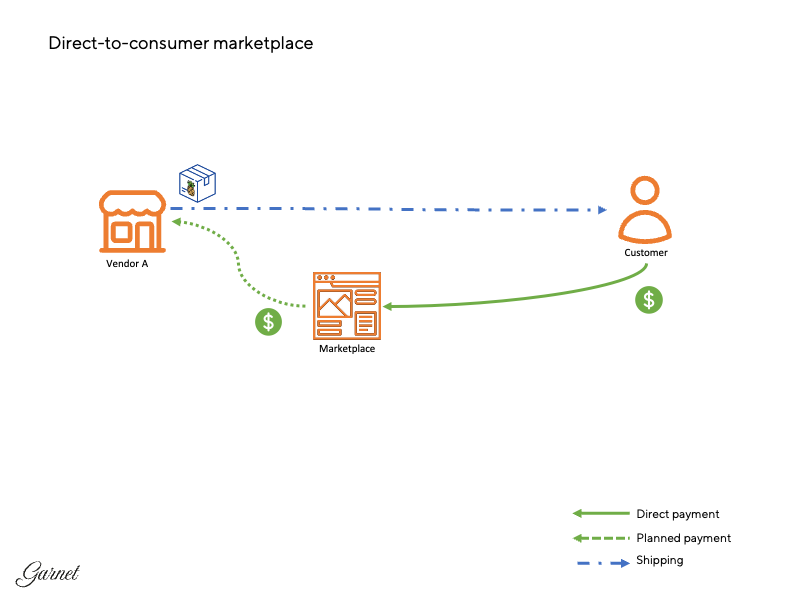
Also called D2C or Dropshipping, the marketplace mainly facilitates the purchase process and is not involved in stocking the items nor shipping them.
Upsides:
- No inventory required: This is the main reason people run marketplaces. The marketplace can display a virtual high number of SKUs online without having to manage more stock.
- Lower operational overhead: Not having to manage shipping simplifies the operation, however the marketplace is responsible for payment processing and often responsible for customer support.
- Faster time to market: it is easier to find vendors than customers. If the market changes, the marketplace can pivot easily by changing vendors rather than selling their inventory.
Downsides:
- Less control over shipping experience: vendors can leave their brand and details on the packaging. You can always contract with them to ensure only the marketplace brand is visible, but an audacious customer can track back the vendor and bypass the marketplace for volume orders.
- Potential for inconsistent delivery times: some sellers might have out of stocks, shipping delays, and other problems that are the responsibility of the marketplace in front of the customer.
- Harder to ensure quality control: we often hear from our clients that the wrong product was shipped, the order was sent twice, or the product was obviously defective. If quality control is important for your business, consider investing in a repacking warehouse.
Use direct to consumer when you want to start an online marketplace and you don’t have an infrastructure in place. 98% of Garnet Marketplace’s users are in this scenario. The main reason to have a warehouse is when the marketplace differentiates itself with controlled shipping and/or thorough quality control.
Referral ecommerce
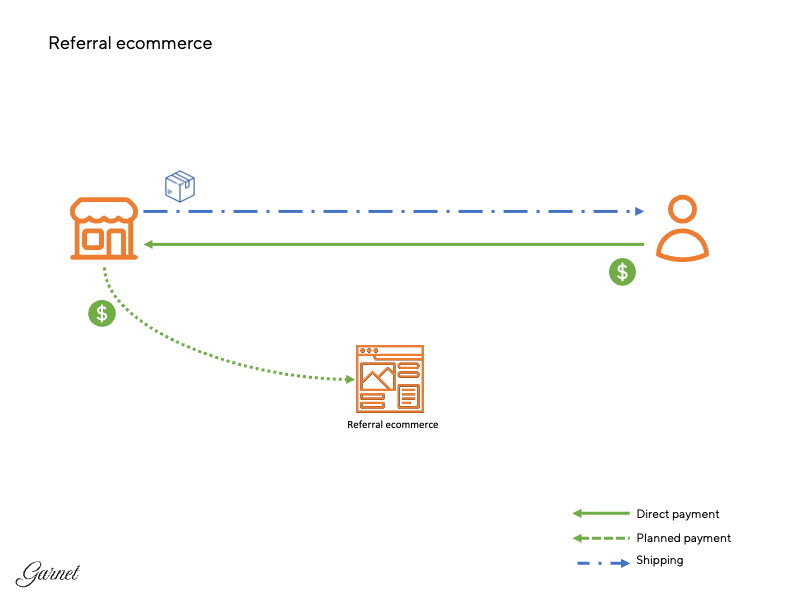
Referral ecommerce is a website that refers the consumer to the vendor’s website. The website is usually paid with a commission on the sales, or on the traffic generated.
Upsides:
- No product, shipping, payment management: everything is taken care of by the vendors. The referral website simply… refers the customer to the vendor.
- Simpler business model: the website focuses on customer acquisition, content creation, and advertisement.
- Easily scalable: The referral model allows for rapid expansion since you don’t need to manage inventory or shipping infrastructure.
Downsides:
- Average customer experience: the customer needs to go through multiple websites to purchase
- High dependence on vendors: the referral website must agree and trust the vendors that the referred leads purchased a product. All the data is held by the vendors.
Use referral ecommerce when:
- You want to test a market with minimal investment,
- You have strong marketing capabilities but limited operational resources,
- Your vendors already have established shipping processes and an ecommerce website,
- You’re primarily focused on customer acquisition.
Overall, referral ecommerce is a good starting point for testing marketplace concepts. Moving to a marketplace model will increase the business revenues, and change the balance of power since the marketplace collects the money then pays back the vendors.
Repacking: aggregation warehouse
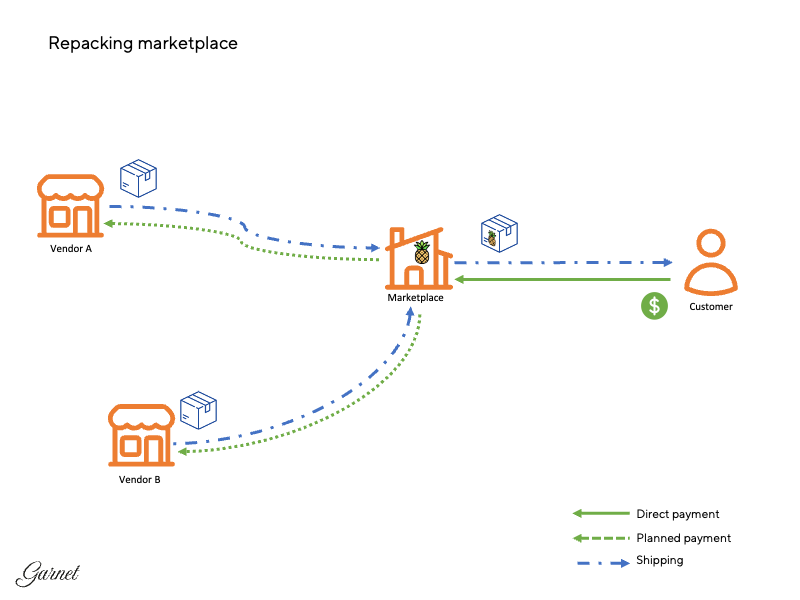
Repacking shipping means that the marketplace receives all products to a warehouse, before sending them to customers.
Upsides:
- Better unboxing customer experience: all items arrive in one package
- Allow quality control: check the items before the customer
- Branded packages: use your brand on the box and label
Downsides:
- Expensive: need to pay for warehouse and package handling
- Shipping delay & additional cost: if the vendor is closer to the customer than the warehouse
- Overhead responsibility: the product can get damaged or lost in the warehouse, incurring additional responsibility to the marketplace.
Use repacking when:
- the marketplace needs a quality check process: Reench is a luxury C2C marketplace that needs to check the authenticity of the products before sending them to the customer. Since this is a mandatory process for the marketplace, repacking products is an obvious solution. The overhead cost and responsibilities are part of their business model. StockX runs the same model at scale: every item passes through its verification centers before it ships to the buyer.
- it’s hard for your vendors to ship to destination: My Ravana specializes in distributing to Sri Lanka. Distributing to Sri Lanka can be challenging for western vendors because of the language barrier, cultural barrier, logistics process, and more. The marketplace becomes a trusted intermediary that takes care of the shipping overhead.
- there are financial incentives: Seoul Onni ships Korean products from Korea to Europe. The marketplace takes care of the importation paperwork, regulation compliance, and simplifies the taxation by having a business in Korea and in Germany. It is then significantly cheaper for vendors to sell to Europe.
Overall, we recommend considering repacking when there is a tangible reason for the marketplace to handle the products, and your marketplace does not compete on pricing. You can always get the branding upside by live shipping rates (below), and do some quality control by selecting your vendors.
Conclusion
If you are starting or have a small business infrastructure, prefer starting with the marketplace model as it allows you to collect the customer money and create a customer base at low cost.
At Garnet we have great experience working with online marketplaces, we’ll be happy to accompany you in your journey. If you are starting a new business, want to expand your current ecommerce platform, or improve the customer experience of your current marketplace, you can fill this contact form.
